
A selection of personalized stories we’ve written for our readers, shared with permission.
A selection of personalized stories we’ve written for our readers, shared with permission.
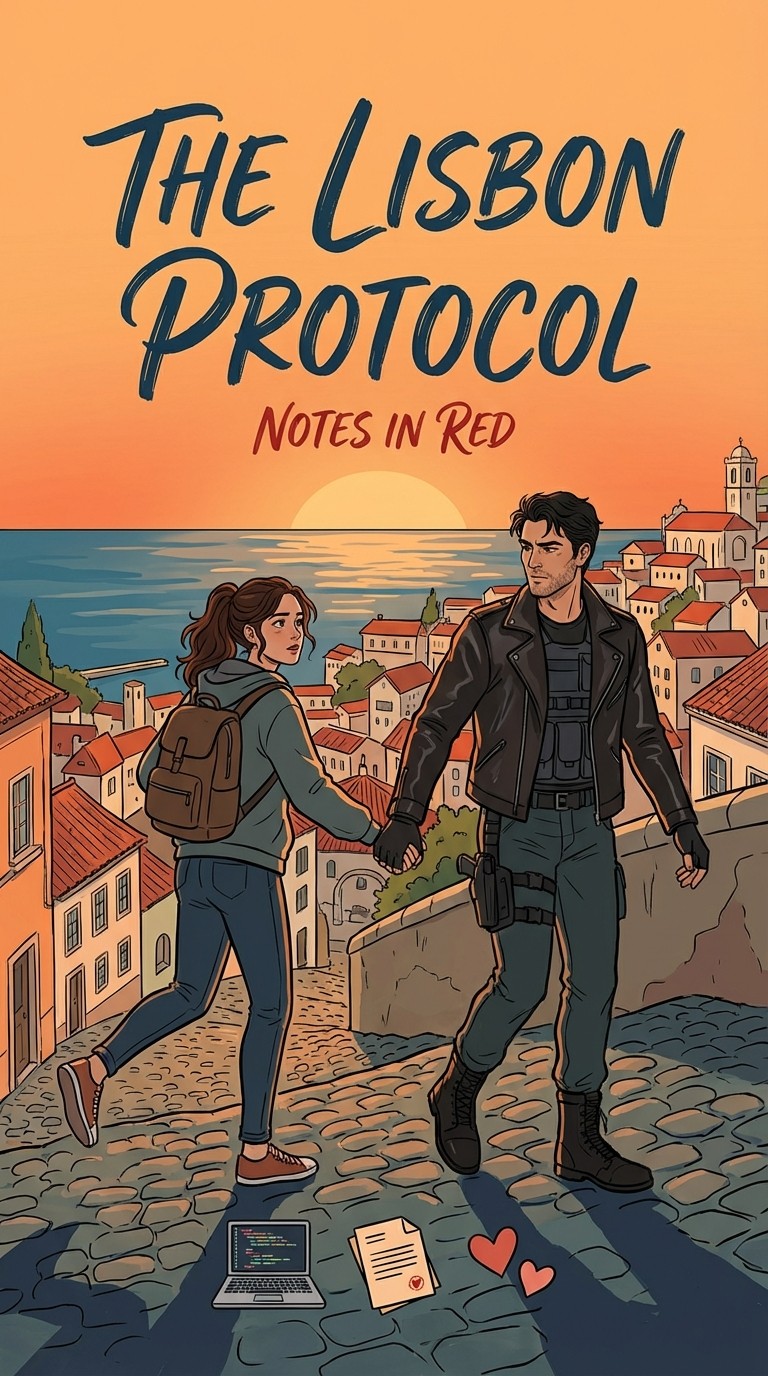
The Lisbon Protocol
A tech whistleblower on the run and the brooding former MI6 operative assigned to protect her discover that surviving a corporate kill squad across the hills of Portugal is easier than surviving the walls they've built around their hearts.
Story Engine: Duty & Danger
Pacing: Slow Burn
Species: Human x Human
A selection of personalized stories we’ve written for our readers, shared with permission.
The Lisbon Protocol
A tech whistleblower on the run and the brooding former MI6 operative assigned to protect her discover that surviving a corporate kill squad across the hills of Portugal is easier than surviving the walls they've built around their hearts.
Story Engine: Duty & Danger
Pacing: Slow Burn
Species: Human x Human
Chapter 1
Some secrets are worth dying for—and some are worth killing to keep. The woman who stepped off the overnight train from Madrid looked nothing like her file photo. Callum Reade had memorized that photo during the twelve-hour briefing: corporate headshot, polished smile, sleek dark hair pulled back in the universal style of tech industry professionalism. The woman walking toward him through Lisbon's Santa Apolónia station had chopped that hair into a jagged bob, dyed it a deep auburn that caught the morning light, and traded the corporate uniform for worn jeans and a leather jacket that had seen better decades. She looked like trouble. She looked like a headache wrapped in attitude and bad decisions. She looked, against all his professional instincts, absolutely magnetic. "You're late," he said when she reached him. "You're taller than your photo suggested." Her eyes—amber brown, sharp with intelligence and something harder underneath—swept over him with an assessment that felt uncomfortably thorough. "Also older. And crankier." "I'm not cranky. I'm efficient. There's a difference." "Sure there is." She adjusted the strap of her backpack. "I'm Mira. But you knew that. You're Callum Reade, former MI6, current contractor for Sentinel Protection Services, and according to my research, you haven't smiled in a photograph since 2019." "You researched me?" "I research everyone. It's how I ended up in this mess." Her mouth curved—not quite a smile, but close enough to suggest she found something amusing about their situation. "Shall we? I assume you have a car waiting, probably black, probably armored, probably with emergency supplies in the trunk because you're the type who prepares for every contingency." She wasn't wrong about any of it, which irritated him more than it should have. Callum led her through the station, hyperaware of their surroundings—the businessman checking his phone too frequently, the couple whose body language didn't quite match their vacation attire, the transit officer whose gaze lingered a beat too long. Six months in the field had honed Mira Santos's instincts for danger, but she was still an amateur. Still vulnerable. Still his responsibility for the next three weeks until the EU tribunal convened and she could finally testify. The file had been comprehensive: twenty-five years old, MIT graduate, rising star at Nexus Technologies until she'd discovered their surveillance software was being sold to authoritarian regimes and used to track dissidents, journalists, and human rights activists. She'd copied the evidence, contacted the EU's whistleblower protection program, and vanished twelve hours before Nexus security could make her disappear permanently. That had been six months ago. Four safe houses. Three close calls. Two protection officers who'd requested reassignment because, according to the reports, she was "unmanageable." Callum had never requested reassignment in fifteen years of protection work. He didn't intend to start now. The car was exactly as she'd described—black, armored, practical. He opened the passenger door and waited while she climbed in, noting the way she automatically checked the mirrors, scanned the street, positioned herself to see both the road ahead and the driver's side approach. Not entirely amateur, then. "The safe house is in the Alentejo region," he said, pulling into Lisbon's chaotic traffic. "About two hours southeast. Remote, defensible, with multiple extraction routes if needed." "My grandmother's estate." "Your grandmother's former estate. She passed three years ago, and the property has been managed by a local trust since then. It provides excellent cover—you're simply the American granddaughter returning to settle family business." "I know. I suggested it." Mira was looking out the window, watching Lisbon's waterfront slide past—the ancient Belém Tower, the Monument to the Discoveries pointing toward the Atlantic like a stone promise. "Avó left it to me. I was supposed to visit after I finished the Nexus project. Turn it into a writing retreat, maybe. Something peaceful." "And instead?" "Instead I found out my company was helping dictators murder journalists, and peaceful stopped being an option." Her voice was flat, matter-of-fact, but Callum caught the tension in her shoulders, the way her hands curled into fists in her lap. "Funny how that works." They drove in silence through the city's outskirts, where concrete apartment blocks gave way to industrial zones and then, gradually, to the rolling cork forests and golden plains of the Alentejo. The landscape was beautiful in a stark, ancient way—olive groves casting shadows across red earth, white-washed villages clustered around medieval churches, the occasional ruined castle marking a hilltop like a broken tooth. "You don't talk much, do you?" Mira asked after the first hour. "I talk when there's something worth saying." "That must make parties a real joy." "I don't go to parties." "Shocking." She shifted in her seat, turning to face him more directly. "Okay, since we're going to be stuck together for three weeks, we should probably establish some ground rules." "I have rules. They involve you staying alive." "Those are your rules. I have my own." She held up a finger. "First: I'm not a package to be delivered. I'm a person. Treat me like one." "I always treat my clients like people." "Your last two clients called me 'the asset.' Directly to my face." Callum's jaw tightened. "They were wrong to do that." "Second rule." Another finger. "I don't do helpless. I've survived six months on my own. I know how to move, how to hide, how to fight if I have to. Don't sideline me because you think protection means wrapping me in cotton wool." "I don't wrap anyone in cotton wool. I keep them alive by making smart decisions." "Good. Then we'll make them together." She lowered her hand. "Third rule: if you're going to be brooding and mysterious, at least make it interesting. The strong-silent-type act gets boring after about twelve hours." "I'm not brooding." "You've had the same expression since the station. It's somewhere between 'existential crisis' and 'constipation.'" Despite himself, Callum felt his mouth twitch. "That's... descriptive." "I'm a details person. It's why I noticed the surveillance logs at Nexus in the first place." She turned back to the window, but he caught the ghost of a smile on her reflection. "So. Callum Reade. Former spy, current babysitter. What made you leave MI6?" "That's classified." "Everything's classified with you people until it isn't. Someone always talks eventually." "I don't." "We'll see." The estate appeared as the afternoon light was turning golden—a sprawling farmhouse of whitewashed walls and terracotta tiles, surrounded by cork oaks and olive groves that stretched to the horizon. It looked peaceful. Serene. The kind of place where nothing bad had ever happened. Callum knew better than to trust appearances. "Home sweet temporary home," Mira said as he pulled through the gate. "There's supposed to be a caretaker. Maria. She was here when I visited as a child." "Maria Ferreira. Sixty-three, former nurse, vetted by Sentinel's Lisbon office. She's been maintaining the property and will provide domestic cover for our presence." "You've investigated everyone." "It's my job." "Must be exhausting. Trusting no one." He parked the car and turned to face her fully for the first time since the station. In the golden light, her features were sharp and striking—high cheekbones that spoke to her Portuguese heritage, a stubborn jaw, full lips currently pressed into a challenging line. Her eyes held his without flinching, and he saw something there that the file hadn't captured: a fierce, unbroken spirit that six months of running hadn't managed to dim. "Trust is earned," he said quietly. "Not given." "Then I guess we'll have to earn it." She opened her door and stepped out into the Portuguese evening. "Race you to the house. Loser makes dinner." She was running before he could respond, backpack bouncing, laughter trailing behind her like a challenge. Callum watched her go, something unfamiliar stirring in his chest. Three weeks. He had to keep her alive for three weeks. He was beginning to suspect it would be the longest—and most complicated—three weeks of his career. His phone buzzed. A message from Sentinel's Lisbon station: Intel update. Nexus has deployed a recovery team. Six operatives, military background. Last tracked heading south from Madrid. The complication had just become considerably more dangerous.
Chapter 2
Some safehouses are safer than others. Recap: Whistleblower Mira Santos arrived in Lisbon under the protection of former MI6 operative Callum Reade. Their first meeting revealed her magnetic defiance and his guarded professionalism. As they reached her grandmother's remote estate in the Alentejo, Callum received word that Nexus had deployed a six-person recovery team—and they were heading south. The farmhouse was exactly as Mira remembered—stone floors worn smooth by generations of feet, thick walls that kept the interior cool even in May's warmth, and the faint scent of cork and olive oil that she'd associated with safety since childhood. Maria Ferreira embraced her with tears and rapid Portuguese, pressing kisses to both cheeks and exclaiming over how much she'd grown, how thin she looked, how her avó would have been so proud to see her return. It was overwhelming and wonderful and made Mira's throat tight with emotions she'd been suppressing for months. "Your grandmother spoke of you often," Maria said, switching to accented English for Callum's benefit. "She kept every photograph, every letter. She knew you would come back someday." "I wish I'd come sooner." "You are here now. That is what matters." Maria's shrewd eyes flickered to Callum, who was conducting a systematic sweep of the ground floor with professional efficiency. "And your friend? He is family also?" "He's... protection." "Ah." Maria's expression shifted to something knowing. "Protection. Yes. He has the look—the careful eyes, the way he watches the doors. My husband was such a man, before he passed. They carry weight, these protectors. Heavy weight." Callum reappeared, his expression unchanged but something in his posture suggesting the sweep had been satisfactory. "The perimeter is clear. I've identified three potential breach points that need reinforcement. Maria, I'll need access to any outbuildings, and I'd like to review your routine—who visits regularly, delivery schedules, that sort of thing." "Of course, senhor. I will show you everything." Maria patted Mira's hand. "You rest. You are safe now." Safe. Mira wasn't sure she remembered what that felt like. She explored the house while Callum interrogated the caretaker, reacquainting herself with rooms she hadn't seen since she was twelve years old. Her grandmother's study, still filled with books on Portuguese history and pressed flowers from the garden. The kitchen where she'd learned to make pastéis de nata, the custard tarts that had been her avó's specialty. The bedroom that had been hers during summer visits, now updated with fresh linens but still containing the same antique mirror where she'd practiced her Portuguese as a girl. The mirror showed her someone different now. Harder. Warier. The rebellion that had always simmered beneath her surface had calcified into something steelier, forged by months of looking over her shoulder and knowing that the people hunting her had resources most governments would envy. But she was still here. Still fighting. Still refusing to let them win. That had to count for something. "You should eat." Callum's voice came from the doorway, making her spin—she hadn't heard him approach. "Maria's prepared something. And we need to discuss the intelligence update." "The one that made you go even more stone-faced than usual? I noticed." "I don't go stone-faced." "You have exactly three expressions: suspicious, more suspicious, and 'actively calculating threat levels.'" She followed him toward the kitchen. "What's the update?" "Nexus has deployed a recovery team. Six operatives, military backgrounds, last tracked heading south from Madrid." He pulled out a chair for her at the worn wooden table. "They'll reach the Alentejo region within forty-eight hours, possibly sooner." Mira sank into the chair, her appetite suddenly gone despite the spread Maria had prepared—fresh bread, local cheese, olives glistening with oil. "Recovery team. That's a nice way of saying 'kill squad.'" "Their primary objective is likely to acquire you alive. You have information they want." "And their secondary objective?" "To ensure that information never reaches the tribunal." His voice was flat, clinical, but his eyes—gray-green and far too perceptive—held something that might have been concern. "We need to adjust our security protocols. Limit your exposure, vary our routines, establish emergency extraction procedures." "So I'm a prisoner again. Just in a prettier cage." "You're alive. That's what matters." "Is it?" The words came out sharper than she intended. "Because sometimes I wonder if all of this—the running, the hiding, the constant fear—is worth it. The tribunal might not even believe me. The evidence might not be enough. Nexus has lawyers and lobbyists and friends in high places, and I have... what? Copied files and good intentions?" Callum was quiet for a moment. Then he pulled out the chair across from her and sat, his long frame folding into the space with surprising grace. "I read your file," he said. "The complete one, not the summary. I know about the journalists in Belarus who were arrested using Nexus software. The activists in Myanmar who disappeared. The human rights lawyer in Cairo who was tracked to her safe house and never seen again." Mira's chest tightened. She'd memorized those names. Carried them like stones. "You exposed that," Callum continued. "You gave up your career, your safety, your entire life to make sure the world knew what was happening. That matters. It matters to the families of the people who died. It matters to the ones who are still alive because you blew the whistle before Nexus could sell to more regimes. And it matters to me, because I spent fifteen years in intelligence watching good people stay silent when speaking up would have cost them." "Is that why you left MI6? Someone stayed silent?" His expression flickered—just for a moment, but she caught it. A crack in the armor. "That's classified." "Everything with you is classified." But she softened, reaching across the table to touch his hand before she could think better of it. "Thank you. For saying that. Sometimes I forget why I'm doing this." His hand was warm under hers, the skin rough with calluses that spoke to years of physical work. He didn't pull away, which surprised her. For a long moment, they sat like that—connected, still, something shifting in the air between them. Then Callum cleared his throat and withdrew his hand. "Eat," he said, his voice slightly rougher than before. "We have a long night of planning ahead." "Planning what, exactly?" "How to keep you alive when six trained operatives come looking for you." He pushed the bread toward her. "It's going to require creativity. I'm told you're good at that." "Who told you that?" "Your file. Apparently you were 'unmanageably creative' in your previous protection details." "I prefer 'adaptively resourceful.'" "I'm sure you do." But his mouth twitched again—that almost-smile she was beginning to recognize. "Eat, Mira. Then we plan. Then we survive." She ate. The bread was warm, the cheese sharp, the olives briny with the taste of this land her grandmother had loved. And across the table, Callum Reade watched over her with those careful gray-green eyes, and Mira felt something she hadn't expected to feel again. Not safety—she knew better than to trust that illusion. But something close to hope. Her phone buzzed. An encrypted message from her contact at the EU: Tribunal date confirmed. Three weeks from today. Stay alive. "Three weeks," she said, showing Callum the message. "Three weeks," he agreed. "We can do three weeks." "You sound almost confident." "I am confident." He met her eyes, and for the first time, she saw something beyond professional detachment. "Keeping you alive is the most important thing I've done in years. I don't intend to fail." The words settled into her chest, warm and unexpected. Three weeks. A remote farmhouse. Six killers on their way. And a man who looked at her like she mattered beyond the information in her head. This was going to be complicated.
Chapter 3
Some routines are survival dressed as normalcy. Recap: At her grandmother's estate, Mira learned that a Nexus recovery team was heading toward the region. Callum's clinical briefing gave way to an unexpected moment of connection when he acknowledged the importance of her sacrifice. With the tribunal confirmed for three weeks away, they began planning their survival strategy. The first week established a rhythm. Mornings began at dawn, with Callum running the perimeter while Mira practiced the self-defense techniques he'd insisted she learn. The lessons were practical, efficient, focused on escape rather than engagement—how to break a grip, how to create distance, how to use her smaller size as an advantage rather than a weakness. "You're holding back," he said on the fourth morning, after she'd failed to break his hold for the third time. "I don't want to hurt you." "I'm not fragile. Again." She tried again. Failed again. His arms were like steel bands around her, his chest a wall of muscle against her back. "You're still thinking too much," he said. "Reaction needs to be instinct, not calculation. When someone grabs you, your body should move before your mind catches up." "Easy for you to say. You've had years of training." "I've had years of necessity. There's a difference." He released her, stepping back. "Take five. We'll try a different approach." The different approach involved him demonstrating escape techniques on her instead—which required him to hold her in various configurations, his hands careful but firm, his voice low in her ear as he explained the mechanics. It was clinical. Professional. Entirely appropriate. It also made her hyperaware of every point where their bodies connected. "Focus," he said, and she realized she'd been holding her breath. "This isn't about strength. It's about leverage and surprise." "Right. Leverage." She executed the move he'd shown her and felt his grip break—a small victory that made her grin despite herself. "Did you see that? I actually did it." "You did." Something warmed in his voice. "Again." Afternoons were for planning and research. Callum had established a secure communications setup, and Mira spent hours reviewing the evidence she'd compiled, preparing her testimony, cross-referencing details that the tribunal's investigators had questioned. It was tedious, meticulous work, but it kept her mind occupied—kept her from dwelling on the recovery team that was somewhere out there, hunting. "You should take breaks," Callum said, appearing with tea one afternoon when she'd been staring at the same spreadsheet for two hours. "I can't afford breaks. There's too much—" "There's always too much. That's not an excuse to burn out before the tribunal even starts." He set the cup beside her laptop. "Maria made pastéis de nata. She says you haven't had any since yesterday." "Maria is a spy for you now?" "Maria is concerned about you. As am I." He pulled a chair next to hers, uninvited but somehow not unwelcome. "What are you working on?" "The Myanmar connection. There's a gap in the documentation—three months where Nexus claims they weren't operating in the region, but I have evidence of server traffic that suggests otherwise." "Show me." She showed him. He leaned in to study the screen, close enough that she could smell him—soap and coffee and something earthier underneath, something that made her want to lean closer rather than pull away. "The timestamp formatting is different here," he said, pointing to a line of code. "See how the regional indicator switches? That's a European server masking as local traffic." "How did you—" "I spent two years tracking financial irregularities in Eastern Europe. Server logs were my light reading." His mouth curved slightly. "You're not the only one who knows how to dig through data." "You're full of surprises, Callum Reade." "I try to keep things interesting." He sat back, and the distance felt like loss. "Take your break. The evidence will still be there in twenty minutes." She took the break. The pastéis de nata were perfect—flaky crust, silky custard, a hint of cinnamon that transported her back to childhood summers in this very kitchen. Maria had clearly been practicing since her avó's passing, keeping the tradition alive for no one in particular. Until now. "These are incredible," she told Maria, who beamed with obvious pleasure. "Your grandmother's recipe. She would be happy to see you enjoying them." "She would be happy to see me period. I never visited enough." "You were building your life. That is what the young must do." Maria's weathered hands covered hers. "She understood. She was proud of you. The clever granddaughter, working with computers, changing the world." "I'm not sure I've changed anything yet." "You have changed everything for the people who will live because of what you exposed. The world does not always see such changes, but they are real." Maria squeezed her hands. "Now. You eat. You rest. You let the handsome protector watch over you." "He's not—" Mira felt heat creep into her cheeks. "It's not like that." "It is not like anything until it is." Maria's eyes twinkled. "I am old, menina, not blind. I see how he watches you. How you watch him when you think he cannot see." "I don't—" "Eat your pastéis." Maria shuffled toward the door. "Some things do not need words. They need only time." That evening, Callum briefed her on the intelligence updates. The recovery team had been spotted in Évora, about an hour north—close enough to worry about, far enough to suggest they hadn't pinpointed the estate yet. "They're being systematic," he said, spreading a map across the kitchen table. "Working through known associates, checking properties linked to your family. It's only a matter of time before they find this place." "How long?" "Days. Maybe less." He met her eyes. "We need contingency plans. Multiple extraction routes, rendezvous points, backup communications." "And if the contingencies fail?" "They won't." "That's not confidence," she said. "That's stubbornness." "In my experience, they're often the same thing." He traced a route on the map with his finger. "If we need to evacuate, the primary route goes south toward the coast. There's a fishing village—Zambujeira do Mar—where I have contacts who can arrange transport. Secondary route heads east into Spain, through the border at Rosal de la Frontera." "You've planned all of this since we arrived?" "I planned most of it before we arrived. Preparation is the difference between survival and—" He stopped, something shifting in his expression. "Between survival and the alternative." "You were going to say 'between survival and death.' Why did you stop?" "Because death isn't an abstraction for you anymore. You've spent six months running from people who want to kill you." His voice softened almost imperceptibly. "I don't need to remind you what's at stake." The consideration caught her off guard. Her previous protection officers had treated the threat like a chess problem—interesting, challenging, impersonal. Callum treated it like her life actually mattered beyond the mission parameters. "Thank you," she said quietly. "For not being clinical about it." "I'm always clinical. I'm just also aware that clinical can be cruel when applied thoughtlessly." He folded the map with precise movements. "We should sleep. Early start tomorrow—I want to scout the secondary route in person." "We?" "You're coming with me. Staying in one place makes you predictable. Movement makes you harder to track." "I thought the whole point was keeping me hidden." "The whole point is keeping you alive. Sometimes that means hiding. Sometimes it means moving. The key is ensuring our enemies never know which we've chosen." He moved toward the door, then paused. "Get some rest, Mira. Tomorrow will be demanding." She watched him go, this complicated man who spoke in tactical assessments but looked at her with something warmer underneath. Maria was right. Some things didn't need words. But Mira wasn't sure either of them was ready for what they might say.
Chapter 4
Some escapes become something else entirely. Recap: The first week established a rhythm of training, research, and preparation. As Mira and Callum grew closer through shared work and unexpected moments of connection, intelligence revealed the Nexus team was in Évora—only an hour away. With contingency plans mapped and danger closing in, Callum decided they needed to scout their escape routes in person. The secondary route took them through landscape that looked prehistoric—rolling plains dotted with ancient dolmens, standing stones that had watched over this land for five thousand years. Callum drove with his usual focused intensity while Mira documented landmarks that might prove useful if they ever had to flee this way in darkness. "There," he said, pulling off the road near a cluster of cork oaks. "The border crossing is two kilometers east. We should walk the approach." The afternoon was warm, the air heavy with the scent of wild herbs and sun-baked earth. They moved through the trees in companionable silence, Callum occasionally pointing out features—a shepherd's hut that could provide shelter, a stream that marked the boundary between properties, a hilltop that offered sight lines in three directions. "You know this land well," Mira observed. "For someone who's never been here before." "Satellite imagery. Topographical maps. Local intelligence from Sentinel's Lisbon station." He helped her over a stone wall, his hand warm and steady on hers. "Preparation, remember?" "Right. Because you never do anything without extensive research." "Would you prefer I improvise with your life?" "I'd prefer you admit that sometimes you're making it up as you go along." She landed on the other side of the wall and turned to face him. "No one is as prepared as you pretend to be. It's not humanly possible." "I never claimed to be entirely human." The words were dry, self-deprecating, and so unexpected that she laughed—a real laugh, full and unguarded. Callum's expression shifted, something warming in those gray-green eyes as he watched her. "That's the first time I've heard you laugh like that," he said. "It's the first time you've been funny." "I'm frequently funny. You're simply not paying attention." "I'm always paying attention to you." The words slipped out before she could stop them, and she saw him go still—that particular stillness he had when processing something unexpected. "I mean—" "I know what you meant." His voice was lower now, rougher. "We should keep moving." They kept moving, but something had shifted between them. The air felt charged, weighted with things neither of them was saying. When they reached the hilltop overlook, the Spanish border visible in the distance, Callum stopped so abruptly that Mira nearly walked into him. "What is it?" "Vehicle. Down by the road we came in on." He pulled her behind a rock formation, his body shielding hers as he raised binoculars to his eyes. "Black SUV. Two occupants visible, possibly more." "Nexus?" "Unknown. Could be coincidence—this area sees tourist traffic." But his hand had moved to the weapon at his hip. "We wait. Watch. See what they do." They crouched together behind the rocks, close enough that Mira could feel the tension radiating off him. Minutes stretched like hours. The SUV sat motionless on the road below, its occupants invisible behind tinted windows. "If they're here for me—" she began. "Then we execute the contingency. Through the trees, across the border, contact point in Rosal." His eyes never left the vehicle. "Stay close to me. Move when I move. Don't look back." "Callum—" "Whatever happens, you keep going. You reach the contact point. You get to that tribunal." His voice was fierce, urgent. "Promise me." "I'm not leaving you—" "Promise me, Mira." The intensity in his eyes stole her breath. This wasn't professional obligation anymore. This was something rawer, more personal. "I promise," she whispered. The SUV's doors opened. Two men emerged, stretching like travelers after a long drive. One consulted a phone; the other lit a cigarette. Their body language was relaxed, casual—tourists checking a map, not operatives hunting a target. After ten minutes, they climbed back into the vehicle and drove away. Mira exhaled shakily. "Just tourists." "Just tourists." But Callum didn't move immediately, his body still pressed against hers in the narrow space between rocks. "That was close. Too close." "It wasn't close. It was nothing." "It felt like something." He turned to face her, and in the confined space, there was nowhere to look but at each other. "Every time I think about losing you—" He stopped, jaw tightening. "About failing this mission—" "Is that what I am? A mission?" "You know you're not." The words hung between them, heavy with implication. Callum's hand came up, almost involuntarily, hovering near her face without quite making contact. "We should go back," he said roughly. "Probably." Neither of them moved. "Mira." Her name was almost a groan. "This is a terrible idea." "Most of my ideas are terrible. They usually work out anyway." "This one won't. We're—there are protocols. Professional boundaries. Reasons why this can't—" "Callum." She closed the distance between them, her hand resting on his chest, feeling his heart hammer beneath her palm. "Shut up." She kissed him. For one endless moment, he was frozen—and then something in him broke. His arms came around her, pulling her against him with a desperation that matched her own. He kissed her like she was oxygen and he'd been drowning, like six months of running had led her not away from danger but toward this—toward him. His hands were in her hair, on her waist, tracing the curve of her spine with an urgency that made her gasp against his mouth. "We can't," he managed between kisses. "This isn't—I'm supposed to protect you—" "You are protecting me." She pulled back just enough to meet his eyes. "But I get to decide who touches me. And I'm deciding it's you." His control wavered visibly. "You don't know what you're asking." "I know exactly what I'm asking." Her hands fisted in his shirt. "I've wanted this since you told me my sacrifice mattered. Since you looked at me like I was more than evidence to be delivered. Since—" He kissed her silent, and this time there was no hesitation. They stayed on that hilltop longer than was tactical, longer than was smart, wrapped in each other with the Spanish border spread out below them and the setting sun turning the landscape to gold. Eventually, sanity reasserted itself enough that they separated, both breathing hard, both looking slightly stunned by what had just happened. "That was—" Callum ran a hand through his hair, disheveling it in a way Mira found unreasonably attractive. "We need to discuss—" "Later." She smoothed her jacket, trying to compose herself. "We discuss it later. Right now, we need to get back before Maria sends a search party." "She wouldn't—" "She absolutely would. She's been waiting for this since day one." "Waiting for what?" "For you to stop being noble and start being human." Mira started down the hill, then turned back with a smile that felt new, reckless, alive. "Come on, protector. Take me home." Callum followed, and she didn't need to look back to know he was watching her with those complicated gray-green eyes. Some things had just gotten considerably more complicated. And she couldn't bring herself to regret it.
Chapter 5
Some surrenders are victories in disguise. Recap: While scouting the secondary escape route, Mira and Callum encountered a vehicle that turned out to be tourists—but the fear of discovery cracked something open between them. Behind an ancient rock formation, they finally kissed, professional boundaries crumbling in the face of feelings neither could deny. Now they must navigate both the external threat and their complicated new reality. The drive back to the estate was quiet but charged, the air between them crackling with unspoken possibility. Maria took one look at them when they walked through the door and smiled with insufferable satisfaction. "Dinner is in an hour," she said, disappearing into the kitchen before either could respond. "She knows," Mira said. "She's been waiting for this, apparently." Callum's voice was dry, but something uncertain flickered in his eyes. "Mira, what happened on the hill—" "Was real. And I don't want to analyze it to death." She turned to face him in the fading light of the entryway. "I want to feel something other than fear. For the first time in six months, I want to feel alive. Is that so wrong?" "It's not wrong. It's just—" He exhaled, some of the tension leaving his shoulders. "Complicated." "Everything about my life is complicated. At least this complication comes with potential benefits." His laugh was startled, almost unwilling. "You're impossible." "I've been told." She stepped closer, close enough to see the conflict playing across his features—duty warring with desire, professionalism battling against something more human. "We have two weeks left. Two weeks of hiding and planning and waiting for people who want me dead. And somewhere in those two weeks, there's going to be a moment when everything falls apart. When the contingencies fail and the escape routes close and it's just us against whatever they send. " "That's not going to happen." "It might. And if it does, I don't want my last regret to be that I was too afraid to take what I wanted when I had the chance." She reached up, her fingers brushing his jaw. "I want you, Callum. Not because you're protecting me. Not because I'm scared and lonely and you're here. Because you're the first person in years who makes me feel like I might actually survive this—and that surviving might be worth it." His eyes closed at her touch, something cracking in his careful composure. "I'm supposed to maintain professional distance," he said quietly. "Then maintain it. Tomorrow. Tonight—" She rose onto her toes, brushing her lips against the corner of his mouth. "Tonight, just be here with me." "Mira." Her name was a ragged whisper. "You don't know what you do to me." "Show me." His control shattered. He kissed her with a ferocity that made the hilltop seem tame, his hands pulling her against him as he walked them both backward toward the stairs. They made it approximately halfway up before he pressed her against the wall, his mouth tracing fire down her throat while her fingers worked blindly at the buttons of his shirt. "Not here," he managed. "Maria—" "Doesn't care. Trust me." "I do." The words seemed to surprise him. "God help me, I do." They stumbled the rest of the way to her room—the room that had been hers as a child, now transformed into something entirely different by the heat building between them. Callum kicked the door closed and then stopped, his chest heaving, his eyes dark with want. "Tell me to stop," he said. "Tell me this is a mistake, and I'll walk away. We'll pretend this never happened, go back to being professional, act like—" "I don't want to pretend." She pulled her shirt over her head, watching his gaze track the movement with gratifying intensity. "I don't want professional. I want you, Callum Reade. All of you." "You have me." He crossed the distance between them in two strides, pulling her against him with hands that trembled slightly. "You've had me since you argued with me in that train station." "I argued because you were being insufferably bossy." "I was being efficient." "You were being—" She lost the thread of thought as his mouth found the sensitive spot below her ear. "Okay, efficiency has its merits." His laugh vibrated against her skin. "I'll take that as a compliment." What followed was both tender and fierce—a claiming and a surrender in equal measure. Callum touched her like she was precious, breakable, and then moments later like she was strong enough to take everything he had to give. He asked permission with his eyes, his hands, whispered words that made her flush with their intensity. "Yes?" he breathed before every escalation. "Yes," she answered every time. "Yes, yes, yes." When they finally came together, Mira cried out at the rightness of it—the feeling of being seen, known, wanted for exactly who she was rather than what she represented. Callum buried his face in her neck and moved with her, finding a rhythm that built toward something bright and inevitable. "Stay with me," he murmured. "Stay with me, Mira." "Always," she promised, and then thought dissolved into sensation. Afterward, they lay tangled together in sheets that smelled of lavender and sunlight, her head on his chest, his fingers tracing idle patterns on her shoulder. The window was open, and the evening breeze carried the scent of cork and wild rosemary. "Regrets?" she asked quietly. "None." His arm tightened around her. "You?" "Only that we waited so long." "It's been eight days." "Like I said. Too long." He laughed, pressing a kiss to her hair. "You really are impossible." "And you're broody and overprotective and terrible at expressing emotions." She propped herself up to look at him. "But I'm starting to think that might be exactly what I need." "I'm not terrible at expressing emotions. I'm selective." "Prove it. Tell me something you've never told anyone." He was quiet for a moment, his gray-green eyes searching her face. "The operation that ended my MI6 career," he said finally. "There was a source. An asset in Syria—a woman who'd been feeding us intelligence on ISIS financing. Her cover was blown because someone in London leaked her identity. They sent me to extract her, but I was too late. She was dead when I arrived. Tortured first." Mira's chest tightened. "Callum—" "I spent six months trying to find out who leaked her. When I got close, I was warned off. Told the leak came from someone too high up to touch." His jaw hardened. "I resigned the next day. I couldn't work for people who would sacrifice a source to protect a bureaucrat." "That's why you took this job. Protecting whistleblowers." "That's why I took every job like this. Because somewhere out there, someone with information is risking everything to expose the truth. And they deserve to know that at least one person will fight to keep them alive." She leaned down and kissed him—soft, tender, full of understanding. "You're a good man, Callum Reade." "I'm a complicated man." "Good and complicated aren't mutually exclusive." She settled back against his chest. "And for what it's worth, I'm glad you're the one protecting me." "So am I." His voice was rough with emotion. "More than I can say." They dozed like that, wrapped in each other, safe for the moment. But somewhere in the darkness beyond their window, headlights moved along a distant road, and the hunting party drew ever closer.
Chapter 6
Some mornings change everything. Recap: Unable to resist any longer, Mira and Callum gave in to their feelings and spent the night together. In the aftermath, Callum shared the story of why he left MI6—a source betrayed by someone untouchable. Their connection deepened, but outside the estate, danger continued to close in. The next morning, Maria served breakfast with pointed looks and too-casual humming. "She's insufferable," Callum muttered, though his hand found Mira's under the table and squeezed gently. "She's happy for us. Let her be insufferable." Mira interlaced her fingers with his. "What's the plan for today?" "Perimeter check. Communication with Sentinel's Lisbon station. And—" His phone buzzed, interrupting him. He read the message, and his expression hardened into something she was beginning to recognize as trouble. "What is it?" "The recovery team. They've been spotted in Mértola." He showed her the map on his phone. "That's forty kilometers northeast. They're getting closer." The warmth of the morning evaporated. "How long before they find us?" "Impossible to say. They're working through a list of properties, but this estate isn't directly linked to you—it's in a trust, under your grandmother's married name. It might buy us time." He stood, already shifting into operational mode. "We need to accelerate our preparations. Pack an emergency bag. Keep it by the door at all times." The day that followed was tense, the easy intimacy of the morning subsumed by practical concerns. Callum ran drills—evacuation procedures, communication protocols, rendezvous points. Mira followed his instructions without argument, saving her energy for the challenges ahead. But even in the midst of preparation, there were moments. "You're doing well," he said, catching her arm after a particularly successful escape drill. "Better than most people I've trained." "I had motivation." She managed a small smile. "Some guy I'm sleeping with seems invested in keeping me alive." "Some guy." His thumb traced circles on her wrist. "Is that what I am?" "What would you prefer?" "I'd prefer—" He stopped, something complicated moving across his features. "I'd prefer to have this conversation when we're not expecting an assault team." "Rain check?" "Rain check." He pressed a kiss to her forehead—brief, almost chaste, but weighted with everything he wasn't saying. "When this is over, we need to talk about what happens next." What happens next. The words lingered in her mind through the afternoon, through dinner, through the quiet hours when they lay together in her narrow bed and listened to the sounds of the Portuguese night. "I don't know what my life looks like after the tribunal," she admitted in the darkness. "Assuming I survive, assuming the testimony matters—what then? I can't go back to tech. I can't go back to normal. I'm not sure I even remember what normal feels like." "You build something new." Callum's voice was quiet beside her. "That's what people do. They survive, and then they build." "What will you build?" "I've been thinking about that." His hand found hers in the dark. "Sentinel wants me to take a permanent position. Training coordinator, based in London. No more fieldwork. No more protection details." "That sounds stable." "It sounds boring." But there was something else in his voice—something that sounded almost like hope. "It also sounds like the kind of job where someone might actually be able to plan a future. Have relationships. Be more than a weapon pointed at threats." "Would you want that? A future?" "I didn't think I would. I've spent fifteen years moving from assignment to assignment, never staying anywhere long enough to matter." His grip tightened on her hand. "But lately I've been thinking that maybe mattering isn't the worst thing in the world." Mira rolled toward him, finding his face in the darkness. "We've known each other twelve days." "Eleven days, six hours, and approximately thirty-seven minutes. But who's counting." "That's not long enough to be making plans." "No. It's not." His hand came up to cup her cheek. "But it might be long enough to start hoping." Hope. It was such a small word for such an enormous thing. "Ask me again," she whispered. "After the tribunal. After we know whether any of this matters." "After the tribunal." He kissed her softly. "It's a date." They fell asleep tangled together, and Mira dreamed of futures she'd stopped believing in—quiet mornings, shared coffee, someone who stayed. She woke to Callum's phone screaming an alert, and the sound of engines in the distance. "They've found us," he said, already moving. "We need to go. Now."
Chapter 7
Some escapes require everything you have. Recap: With the Nexus team closing in—spotted only forty kilometers away—Callum and Mira accelerated their preparations while stealing moments of intimacy. Callum revealed he was considering a stable position in London, sparking hope for a future together. But their quiet conversation was shattered when alerts signaled the enemy had found the estate. The evacuation was chaos managed through training. Mira grabbed the emergency bag while Callum barked instructions into his phone—Sentinel was scrambling a response, but the nearest support was hours away. Maria appeared in the hallway, face pale but composed, a shotgun that had probably belonged to Mira's grandfather clutched in her weathered hands. "Go," she said. "The south gate—I kept the key hidden, even from the trust. They will not know about it." "Maria, you can't stay—" "I am an old woman who knows this land. They want you, menina, not me. I will delay them." Her eyes were fierce. "Your grandmother would expect nothing less." There was no time to argue. Callum pulled Mira toward the back of the house, through the kitchen, out into the predawn darkness. The sound of vehicles was closer now—two, maybe three, approaching from the main road. "The south gate," he said. "Where?" "Through the orchard. There's a wall—look for the cork oak with the twisted trunk." They ran. The orchard was a maze of ancient trees, their branches creating a canopy that blocked what little moonlight remained. Mira's lungs burned, her legs ached, but Callum's hand on hers was steady, pulling her forward with an urgency that brooked no weakness. Behind them, shouting. The crash of a door being forced. Maria's voice, raised in rapid Portuguese, buying them precious seconds. "There." Callum pointed to a massive cork oak, its trunk bent at an impossible angle, a remnant of some long-ago storm. Behind it, nearly invisible in the darkness, was a wooden gate set into the stone wall. The key was hidden in a hollow at the base of the tree—exactly where Maria had promised. Callum unlocked the gate with hands that were perfectly steady despite everything, and they slipped through into the wild land beyond the estate's boundaries. "The extraction point," he said, already consulting his phone. "Two kilometers southwest. We need to move." They moved. The terrain was rough—rocky hillsides, dense scrub, the occasional dry streambed that required careful navigation. But Mira had trained for this, and more importantly, she had Callum. He guided her through the worst patches, his presence a constant reassurance in the darkness. "They'll track us," she gasped, scrambling over a boulder. "When they find the gate—" " By then we'll be in position. Trust me." She did. That was the terrifying part—she trusted him completely, with her life, with everything she had. The extraction point was a clearing on the edge of a cork forest, barely visible in the growing light of dawn. Callum checked his phone, swore softly. "Transport is thirty minutes out. We need to hold here." "And if they find us before then?" "Then we improvise." He pulled his weapon, checking it with practiced efficiency. "Stay low, stay quiet, and if I tell you to run—" "I know. I run." She touched his arm. "But I'm not leaving you." "Mira—" "I said I know the protocol. That doesn't mean I'll follow it." Her chin lifted stubbornly. "We're in this together. All of it." He stared at her for a long moment, something fierce and tender warring in his expression. "You're the most stubborn person I've ever met." "That's what makes me charming." "That's what's going to give me a heart attack." But he pulled her close, pressing a hard kiss to her forehead. "When this is over, we're having a serious conversation about following instructions." "Looking forward to it." They waited. The minutes crawled past, each one an eternity. The sun rose, painting the landscape in shades of gold and amber, and somewhere in the distance, Mira could hear the sound of a helicopter approaching. "That's ours," Callum said, relief evident in his voice. But before the helicopter could reach them, figures emerged from the tree line—three men in tactical gear, weapons raised, moving with the coordinated precision of professionals. "Get behind me." Callum's voice was calm, controlled, the voice of someone who had faced worse and survived. "When the chopper arrives, you run for it. Don't stop, don't look back." "Callum—" "I'll be right behind you. I promise." The first shot came from the left, shattering the morning silence. Callum returned fire, his accuracy devastating—one of the figures dropped, then another. But the third kept coming, and more were emerging from the trees. The helicopter descended into the clearing, rotors whipping dust and debris into a blinding cloud. A door slid open, and a voice shouted for them to move. "Go!" Callum grabbed her arm, pushing her toward the aircraft. "NOW!" Mira ran. The distance to the helicopter felt infinite—ten meters, then five, then she was being hauled inside by hands she couldn't see, pulled onto the cold metal floor as the aircraft began to rise. "Callum!" She screamed his name, fighting to see through the chaos. And then he was there—climbing aboard with blood on his arm but very much alive, collapsing beside her as the helicopter banked hard and accelerated away from the chaos below. "You're hurt," she managed. "Graze. I've had worse." He pulled her close, his uninjured arm wrapping around her with desperate strength. "You're okay. You're okay." "We made it." "We made it." He pressed his forehead to hers, breathing hard. "I told you the contingencies would work." "The contingencies involved you getting shot." "A minor miscalculation." But he was smiling—actually smiling, for the first time since she'd known him—and the sight made her chest ache with something she wasn't ready to name. The helicopter carried them toward Lisbon, toward safety, toward a tribunal that would change everything. And Mira held onto Callum and let herself believe that maybe, just maybe, they might actually survive this.
Chapter 8
Some truths can no longer be contained. Recap: The Nexus team found the estate, forcing Mira and Callum into a desperate evacuation. With Maria's help, they escaped through a hidden gate and made it to the extraction point—but not before a firefight that left Callum wounded. The helicopter carried them toward Lisbon, battered but alive, with the tribunal only days away. The safe house in Lisbon was a far cry from the estate—a cramped apartment above a pastry shop in the Alfama district, chosen for its anonymity rather than its charm. Callum's wound turned out to be worse than a graze—a clean through-and-through that required stitches and painkillers and his extremely reluctant agreement to let Mira change his bandages. The Sentinel medic who treated him pronounced him 'lucky,' which earned a look of such withering contempt that Mira had to fake a coughing fit to hide her laughter. "Lucky," Callum muttered after the medic left. "I got shot protecting someone. That's not luck. That's doing my job." "Your job involved taking a bullet for me?" "My job involved keeping you alive. Sometimes bullets are part of that equation." He shifted on the narrow bed, wincing. "You should be preparing your testimony, not playing nurse." "I've prepared my testimony for six months. A few more hours won't change anything." She sat on the edge of the bed, her hand finding his. "You scared me. When I saw the blood—" "I'm fine." "You got shot." "I've been shot before." "That doesn't make it better." Her voice cracked, and she felt the emotion she'd been suppressing since the helicopter finally break through. "Callum, if something had happened to you—" "Nothing happened." He pulled her toward him with his uninjured arm. "I'm here. We're both here. That's what matters." "I know. But—" She pressed her face to his chest, breathing him in. "I was so scared. I've been scared for six months, but this was different. This was—" "Personal." "Yes." She looked up at him, tears she couldn't hide streaming down her cheeks. "I love you." The words came out before she could stop them, hanging in the small room like a held breath. Callum went very still. "Mira—" "I know it's too soon. I know we've only known each other two weeks. I know there are a hundred reasons why this is crazy and impractical and probably doomed." She wiped at her tears with her free hand. "But I almost lost you today, and I realized I couldn't let another moment pass without telling you. I love you, Callum. Not because you saved me. Because you see me—the real me, the stubborn and reckless and impossible me—and you don't try to make me into something else." "Mira." His voice was rough, his eyes bright with something she'd never seen there before. "I've been in love with you since you walked off that train and told me I was taller than my photo suggested." "That's—" She laughed through her tears. "That's not romantic." "No. But it's true." His hand came up to cup her face. "I've spent fifteen years keeping everyone at arm's length. Professional distance. Emotional boundaries. All the things they train you to maintain so that losing someone doesn't destroy you. And then you appeared—arguing, challenging, refusing to be managed—and every single barrier I'd built just... crumbled." "I didn't mean to crumble your barriers." "I know. That made it worse." He smiled—that rare, devastating smile. "You weren't trying to break through. You just did. And by the time I realized what was happening, it was already too late." "Too late?" "I was already in love with you." He pulled her closer, pressing his forehead to hers. "I love you, Mira Santos. Against every protocol, every instinct, every professional standard I've ever maintained. I love you, and when this tribunal is over, I want to figure out what comes next. Together." She kissed him—careful of his wound, but fierce nonetheless. "Together," she whispered against his mouth. "I like the sound of that." "Good." His uninjured hand tangled in her hair. "Because I'm not letting you go. Not now. Not ever." They stayed like that for a long moment, wrapped in each other, the chaos of the morning finally settling into something like peace. Then Callum's phone rang. "Sentinel," he said, checking the screen. He answered, listened, and his expression shifted through several shades of concern before settling on grim determination. "Understood. We'll be ready." "What is it?" "The tribunal's been moved up. They want your testimony day after tomorrow." He set down the phone. "Apparently there's concern about security—Nexus has been making noise, political pressure, the usual. The EU wants this over with before it can be buried." "Day after tomorrow." Mira felt reality come crashing back. "That's—soon." "It's very soon." He took her hand. "Are you ready?" "I've been ready for six months. I just hoped I'd have more time before—" She squeezed his fingers. "Before going back to real life." "This is real life." His eyes held hers. "Everything that's happened—the danger, the running, us—it's all real. The tribunal doesn't change that." "But after the tribunal—" "After the tribunal, we figure out what's next. You said you'd give me a chance to ask again." His mouth curved. "I intend to hold you to that." "I'm counting on it." The next thirty-six hours were a blur of preparation. Mira reviewed her testimony until she could recite it in her sleep. Callum coordinated security for the tribunal building, running scenarios, identifying vulnerabilities, ensuring that Nexus couldn't reach her even in the heart of official EU territory. Through it all, they stole moments—quick kisses, murmured reassurances, hands that found each other whenever proximity allowed. "You're going to be brilliant," Callum said the night before, as they lay together in the cramped bed. "You're going to walk into that room and make them understand exactly what Nexus has been doing. And the world is going to change because you had the courage to speak." "What if they don't believe me?" "They'll believe you." His confidence was absolute. "I've watched you talk about this evidence for two weeks. You know it inside and out. You care about the people it protects. That kind of conviction is impossible to fake." "And if Nexus tries something?" "Then I'll stop them." His arm tightened around her. "That's what I do. That's what I'll keep doing, for as long as you need me." "And if I need you forever?" "Then you'll have me forever." He pressed a kiss to her hair. "Sleep now. Tomorrow changes everything." Tomorrow. Mira closed her eyes and dreamed of justice, of futures, of a man who loved her enough to take a bullet and still come back for more. Tomorrow would change everything. She was finally ready.
Chapter 9
Some victories are won in the light. Recap: In the Lisbon safe house, with Callum wounded and the danger momentarily past, Mira finally said the words she'd been holding back: "I love you." Callum confessed he'd loved her since the train station. But their moment of peace was cut short—the tribunal had been moved up, and in thirty-six hours, Mira would testify. The tribunal chamber was smaller than Mira had imagined—a wood-paneled room in Brussels that somehow managed to feel both official and intimate. Three judges sat behind an elevated desk, their expressions carefully neutral. Lawyers representing Nexus occupied one table; EU prosecutors occupied another. And in the center, a witness stand that had never felt quite so intimidating. Callum was positioned near the door, close enough that she could see him, far enough to maintain professional distance. His presence was a steady anchor in the storm of her nerves. The testimony took six hours. Mira walked through the evidence methodically—the server logs, the financial records, the communications that proved Nexus had knowingly sold surveillance software to regimes with documented human rights violations. She named the journalists who had been tracked, the activists who had disappeared, the lawyer in Cairo whose location had been compromised by technology that was supposed to protect privacy. The Nexus lawyers tried to shake her. They questioned her methodology, her motives, her personal life. They implied she was a disgruntled employee seeking revenge. They suggested the evidence had been manufactured. Through it all, Mira remained calm. She had the data. She had the truth. And every time her confidence wavered, she looked toward the door and found Callum watching with those gray-green eyes that said more than any words could. "No further questions," the lead judge finally said, and Mira felt the weight of six months slide off her shoulders. She had done it. The hours that followed were a blur of procedural details and security escorts. The tribunal would deliberate, the judges announced; a decision would be forthcoming. But as Mira was led through corridors and into waiting vehicles, she caught snippets of conversation that suggested the outcome wasn't really in doubt. "Damning evidence," she heard one prosecutor murmur. "They'll face sanctions at minimum," another replied. By the time she and Callum reached the secure apartment Sentinel had arranged in Brussels, Mira was exhausted—physically, emotionally, completely drained. "You were incredible," Callum said as soon as the door closed behind them. "I was terrified." "You were incredible and terrified. The two aren't mutually exclusive." He pulled her into his arms. "I've watched a lot of people testify in high-pressure situations. What you did in there—keeping your composure, countering every attack, making them understand the human cost—that was extraordinary." "I kept looking at you." She buried her face in his chest. "Every time I started to lose focus, I looked at you, and it reminded me why I was doing this." "I noticed." His hands stroked her back. "I was worried my presence might be distracting." "It was. But in a good way." She looked up at him. "In the best way." "Mira." His voice was rough with emotion. "I love you." "I love you too." She rose onto her toes and kissed him. "Now. About that conversation you wanted to have—" "After the verdict." "The verdict could take days." "Then we wait days." But his resolve was visibly weakening as her hands slid under his shirt. "Mira—" "I just testified against a multinational corporation in front of an international tribunal. I think I've earned a celebration." She pulled him toward the bedroom. "Don't you?" His resistance lasted approximately three more seconds. They came together with a desperation born of relief—the danger past, the testimony given, the future finally within reach. Callum touched her like she was precious and powerful in equal measure, his wounded arm forgotten as he mapped her body with patient attention. "Tell me what you want," he breathed against her skin. "You. Just you. Forever." "Forever." He positioned himself above her, eyes dark with want. "That's a long time." "I know." She pulled him down. "Start now." They moved together with an urgency that built toward something inevitable. When Mira finally fell apart in his arms, she cried out his name like a prayer, and he followed her over the edge with a groan that shook through both of them. Afterward, wrapped in unfamiliar sheets in an unfamiliar city, Mira felt more at home than she had in years. "The London job," she said into the quiet. "Are you going to take it?" "I've been thinking about it." His fingers traced idle patterns on her shoulder. "The training coordinator position. It would mean stability. A home base. The kind of life where I could actually plan for things." "Plan for what things?" "Things involving you." He tilted her chin up to meet his eyes. "I know you don't know what comes next. I know your life is uncertain and complicated and probably about to change dramatically. But whatever it becomes—wherever you end up—I want to be there." "Even if it's boring?" "Especially if it's boring. I've had enough excitement to last several lifetimes." His mouth curved. "Besides, you could never be boring. Infuriating, challenging, impossible—but never boring." "That's very sweet. In a backhanded way." "I'm a work in progress." She laughed, pulling him close. "Okay," she said. "Take the London job. Let's see what normal looks like." "Is that a yes?" "It's a 'let's try.' A 'let's see.' A 'I've never done this before but I want to figure it out with you.'" "That's more than enough." He kissed her softly. "That's everything." They fell asleep tangled together, and when morning came with news that the tribunal had ruled in her favor—sanctions against Nexus, criminal referrals for key executives, international condemnation that made headlines around the world—Mira received it with tears and laughter and Callum's arms around her. She had won. And for the first time in her life, victory felt like the beginning of something rather than the end.
Chapter 10
Some endings are just beginnings in disguise. Recap: Mira's six-hour testimony at the EU tribunal was a triumph. That night, she and Callum celebrated privately, exchanging declarations and deciding to try for a future together. Morning brought the verdict: sanctions against Nexus, criminal referrals, and international headlines. The battle was finally won. Six months later. The flat in Hampstead wasn't large, but it had good light and a small garden that Mira had filled with herbs she was slowly learning to cultivate. Callum had opinions about proper watering schedules. She ignored most of them. "You're overwatering the basil again," he said, appearing in the doorway with two cups of tea. "I'm giving it love." "You're drowning it." "Your concern is noted and disregarded." She accepted the tea and pressed a kiss to his cheek. "How was the training session?" "Productive. The new recruits are promising—eager, teachable, only moderately reckless." He settled onto the garden bench beside her. "How was the writing?" "Also productive. The publisher wants the manuscript by October. I think I can make it." The book had been Mira's idea—a full account of the Nexus investigation, the whistleblowing process, and the tribunal that followed. Part memoir, part investigative journalism, part manifesto for others considering similar paths. It had already attracted significant attention, and the advance had been enough to fund a year of writing while she figured out what came next. "You'll more than make it," Callum said with characteristic certainty. "You'll deliver early and make them wonder why they ever doubted you." "Your confidence in me is occasionally overwhelming." "My confidence in you is entirely justified." He took her hand. "I've watched you face down assassination teams, hostile lawyers, and Maria's opinions about proper Portuguese cooking. A publishing deadline is nothing." "Maria would be devastated to hear you call her opinions hostile." "Maria would be delighted. She loves being formidable." He squeezed her fingers. "Speaking of which, she called this morning. Wants to know when we're visiting the estate again." The estate had survived the Nexus incursion with minimal damage—a broken door, some shattered windows, nothing that couldn't be repaired. Maria had remained as caretaker, fiercely protective of the property that had sheltered Mira during the most dangerous weeks of her life. "Soon," Mira said. "Maybe next month? I want to show you the villages in the hills. My grandmother used to take me there when I was little—there's this bakery that makes the most incredible sweet bread—" "Mira." Callum's voice had shifted, something careful entering his tone. "There's something I need to ask you." She turned to face him, finding his gray-green eyes soft with an emotion she'd learned to recognize over the past months. "That sounds ominous." "It's not meant to be." He reached into his pocket and withdrew a small box. "I've been carrying this around for three weeks, trying to find the right moment. But I've realized there is no right moment. There's only now." Mira's heart stuttered. "Callum—" "Let me finish." He opened the box, revealing a simple ring—a single sapphire set in white gold, elegant and understated. "I love you. I've loved you since a train station in Lisbon, and every day since then, I've loved you more. You made me believe in futures I'd given up on. You made me want things I'd convinced myself I didn't deserve. And I want to spend the rest of my life being the person you deserve—someone who challenges you and supports you and loves you exactly as you are." "Callum." Her voice cracked. "Mira Santos, will you marry me?" The question hung in the air of their small garden, surrounded by overwatered herbs and the distant sounds of London traffic. "Yes." The word came out immediately, absolutely, without a moment's hesitation. "Yes, of course, yes." His smile was sunrise. He slid the ring onto her finger with hands that trembled slightly—this man who had faced gunfire without flinching, undone by a single word. Then he pulled her close and kissed her, and Mira felt the last of her walls crumble into something that felt like peace. "I love you," she whispered against his mouth. "I love you too." His forehead rested against hers. "Forever." "Forever's a long time." "Then we'd better get started." They sat together in the garden as afternoon faded toward evening, planning a future neither of them had expected—weddings and holidays, the estate in Portugal that would become their second home, the children that might someday fill rooms that had been silent too long. "I never thought I'd have this," Mira said as the stars began to emerge. "A home. A person. A life that feels like it actually belongs to me." "You always deserved it." Callum's arm tightened around her. "You just needed someone stubborn enough to help you see it." "I was the stubborn one." "We were both stubborn. It's why we work." She laughed, leaning into his warmth. The road that had brought her here—the whistleblowing, the running, the tribunal, the danger—had cost her almost everything. Her career, her anonymity, her illusions about the world she'd worked in. But it had also given her this. A man who loved her. A future worth fighting for. A life that was finally, completely her own. In Lisbon, she had been running. In London, she had found home. And in the years that followed, as her book became a touchstone for other whistleblowers, as Nexus faced the consequences of its crimes, as she and Callum built a life filled with love and laughter and the occasional argument about herbs—she never forgot the lesson those desperate weeks had taught her. Some secrets were worth risking everything to tell. And some people were worth risking everything to love.
Create your story today.
Chapter 1
Some secrets are worth dying for—and some are worth killing to keep. The woman who stepped off the overnight train from Madrid looked nothing like her file photo. Callum Reade had memorized that photo during the twelve-hour briefing: corporate headshot, polished smile, sleek dark hair pulled back in the universal style of tech industry professionalism. The woman walking toward him through Lisbon's Santa Apolónia station had chopped that hair into a jagged bob, dyed it a deep auburn that caught the morning light, and traded the corporate uniform for worn jeans and a leather jacket that had seen better decades. She looked like trouble. She looked like a headache wrapped in attitude and bad decisions. She looked, against all his professional instincts, absolutely magnetic. "You're late," he said when she reached him. "You're taller than your photo suggested." Her eyes—amber brown, sharp with intelligence and something harder underneath—swept over him with an assessment that felt uncomfortably thorough. "Also older. And crankier." "I'm not cranky. I'm efficient. There's a difference." "Sure there is." She adjusted the strap of her backpack. "I'm Mira. But you knew that. You're Callum Reade, former MI6, current contractor for Sentinel Protection Services, and according to my research, you haven't smiled in a photograph since 2019." "You researched me?" "I research everyone. It's how I ended up in this mess." Her mouth curved—not quite a smile, but close enough to suggest she found something amusing about their situation. "Shall we? I assume you have a car waiting, probably black, probably armored, probably with emergency supplies in the trunk because you're the type who prepares for every contingency." She wasn't wrong about any of it, which irritated him more than it should have. Callum led her through the station, hyperaware of their surroundings—the businessman checking his phone too frequently, the couple whose body language didn't quite match their vacation attire, the transit officer whose gaze lingered a beat too long. Six months in the field had honed Mira Santos's instincts for danger, but she was still an amateur. Still vulnerable. Still his responsibility for the next three weeks until the EU tribunal convened and she could finally testify. The file had been comprehensive: twenty-five years old, MIT graduate, rising star at Nexus Technologies until she'd discovered their surveillance software was being sold to authoritarian regimes and used to track dissidents, journalists, and human rights activists. She'd copied the evidence, contacted the EU's whistleblower protection program, and vanished twelve hours before Nexus security could make her disappear permanently. That had been six months ago. Four safe houses. Three close calls. Two protection officers who'd requested reassignment because, according to the reports, she was "unmanageable." Callum had never requested reassignment in fifteen years of protection work. He didn't intend to start now. The car was exactly as she'd described—black, armored, practical. He opened the passenger door and waited while she climbed in, noting the way she automatically checked the mirrors, scanned the street, positioned herself to see both the road ahead and the driver's side approach. Not entirely amateur, then. "The safe house is in the Alentejo region," he said, pulling into Lisbon's chaotic traffic. "About two hours southeast. Remote, defensible, with multiple extraction routes if needed." "My grandmother's estate." "Your grandmother's former estate. She passed three years ago, and the property has been managed by a local trust since then. It provides excellent cover—you're simply the American granddaughter returning to settle family business." "I know. I suggested it." Mira was looking out the window, watching Lisbon's waterfront slide past—the ancient Belém Tower, the Monument to the Discoveries pointing toward the Atlantic like a stone promise. "Avó left it to me. I was supposed to visit after I finished the Nexus project. Turn it into a writing retreat, maybe. Something peaceful." "And instead?" "Instead I found out my company was helping dictators murder journalists, and peaceful stopped being an option." Her voice was flat, matter-of-fact, but Callum caught the tension in her shoulders, the way her hands curled into fists in her lap. "Funny how that works." They drove in silence through the city's outskirts, where concrete apartment blocks gave way to industrial zones and then, gradually, to the rolling cork forests and golden plains of the Alentejo. The landscape was beautiful in a stark, ancient way—olive groves casting shadows across red earth, white-washed villages clustered around medieval churches, the occasional ruined castle marking a hilltop like a broken tooth. "You don't talk much, do you?" Mira asked after the first hour. "I talk when there's something worth saying." "That must make parties a real joy." "I don't go to parties." "Shocking." She shifted in her seat, turning to face him more directly. "Okay, since we're going to be stuck together for three weeks, we should probably establish some ground rules." "I have rules. They involve you staying alive." "Those are your rules. I have my own." She held up a finger. "First: I'm not a package to be delivered. I'm a person. Treat me like one." "I always treat my clients like people." "Your last two clients called me 'the asset.' Directly to my face." Callum's jaw tightened. "They were wrong to do that." "Second rule." Another finger. "I don't do helpless. I've survived six months on my own. I know how to move, how to hide, how to fight if I have to. Don't sideline me because you think protection means wrapping me in cotton wool." "I don't wrap anyone in cotton wool. I keep them alive by making smart decisions." "Good. Then we'll make them together." She lowered her hand. "Third rule: if you're going to be brooding and mysterious, at least make it interesting. The strong-silent-type act gets boring after about twelve hours." "I'm not brooding." "You've had the same expression since the station. It's somewhere between 'existential crisis' and 'constipation.'" Despite himself, Callum felt his mouth twitch. "That's... descriptive." "I'm a details person. It's why I noticed the surveillance logs at Nexus in the first place." She turned back to the window, but he caught the ghost of a smile on her reflection. "So. Callum Reade. Former spy, current babysitter. What made you leave MI6?" "That's classified." "Everything's classified with you people until it isn't. Someone always talks eventually." "I don't." "We'll see." The estate appeared as the afternoon light was turning golden—a sprawling farmhouse of whitewashed walls and terracotta tiles, surrounded by cork oaks and olive groves that stretched to the horizon. It looked peaceful. Serene. The kind of place where nothing bad had ever happened. Callum knew better than to trust appearances. "Home sweet temporary home," Mira said as he pulled through the gate. "There's supposed to be a caretaker. Maria. She was here when I visited as a child." "Maria Ferreira. Sixty-three, former nurse, vetted by Sentinel's Lisbon office. She's been maintaining the property and will provide domestic cover for our presence." "You've investigated everyone." "It's my job." "Must be exhausting. Trusting no one." He parked the car and turned to face her fully for the first time since the station. In the golden light, her features were sharp and striking—high cheekbones that spoke to her Portuguese heritage, a stubborn jaw, full lips currently pressed into a challenging line. Her eyes held his without flinching, and he saw something there that the file hadn't captured: a fierce, unbroken spirit that six months of running hadn't managed to dim. "Trust is earned," he said quietly. "Not given." "Then I guess we'll have to earn it." She opened her door and stepped out into the Portuguese evening. "Race you to the house. Loser makes dinner." She was running before he could respond, backpack bouncing, laughter trailing behind her like a challenge. Callum watched her go, something unfamiliar stirring in his chest. Three weeks. He had to keep her alive for three weeks. He was beginning to suspect it would be the longest—and most complicated—three weeks of his career. His phone buzzed. A message from Sentinel's Lisbon station: Intel update. Nexus has deployed a recovery team. Six operatives, military background. Last tracked heading south from Madrid. The complication had just become considerably more dangerous.
Chapter 1
When concrete meets wildflowers, something has to give. Maya Reyes had fielded a lot of ridiculous phone calls in her three years running the Southside Greenway Project, but this one ranked somewhere between the woman who wanted to rent their community garden for a goat yoga influencer shoot and the alderman who suggested they "pivot to crypto." "I'm sorry," she said, wedging her phone between her ear and shoulder while she wrestled a bag of mulch off the truck bed. "You want to schedule a what?" "A preliminary site assessment," the voice on the other end repeated, clipped and professional. "Ashford Development would like to discuss the future of your property." "It's not a property. It's a garden. And there's nothing to discuss." "Mr. Ashford has asked me to convey that he's prepared to offer extremely generous terms—" "Tell Mr. Ashford he can take his generous terms and compost them." Maya ended the call and shoved the phone into her back pocket, then immediately felt guilty. Her grandmother would've told her that was no way to handle business, even bad business. But her grandmother had also believed in fairies, so. The Southside Greenway stretched across two acres of what used to be an abandoned lot, now transformed into raised beds, fruit trees, a greenhouse, and the centerpiece: a crumbling but beloved Victorian gazebo where neighborhood kids did homework while their parents worked the plots. Maya had poured four years of her life into this place—first as a volunteer during college, then as the youngest program director the nonprofit had ever hired. And now some developer wanted to turn it into what? Luxury condos? A parking structure? Another soulless glass tower? Over her decomposing body. "That face means trouble." Delia Washington, the Greenway's seventy-two-year-old master gardener, appeared from between the tomato rows, her silver locs piled high under a wide-brimmed hat. "What now?" "Ashford Development." Delia's expression flickered. "Dominic Ashford?" "You know him?" "Know of him. His company's been buying up half the South Side. But I've also heard..." She paused, seeming to choose her words. "There's old money behind that family. Old ways. Some folks say they're different." "Different how?" Delia just shrugged, a gesture that somehow communicated both everything and nothing. "You'll see for yourself soon enough, I imagine. Men like that don't take no for an answer." She was right. Three hours later, Maya was elbow-deep in the compost bins when a black town car slid to a stop at the garden's chain-link entrance. The man who emerged didn't belong here. That was Maya's first thought—that he looked like someone had Photoshopped a magazine cover onto her neighborhood. He was tall, broad-shouldered in a way that his charcoal suit couldn't quite civilize, with dark hair pushed back from a face that was all sharp angles and intensity. His jaw could've been carved from the same limestone as the old Chicago water tower, and his eyes—she caught the color even from twenty feet away—were an unsettling amber-gold, like whiskey held up to afternoon light. He moved wrong, too. That was her second thought. Most men in suits walked like they owned the sidewalk. This one walked like he was tracking something, his gaze sweeping the garden with an alertness that seemed almost predatory. A thin scar traced his left eyebrow, disappearing into his hairline—the only imperfection on an otherwise annoyingly symmetrical face. Maya wiped her hands on her jeans and went to meet him at the gate. "Mr. Ashford, I presume." "Ms. Reyes." His voice was lower than she'd expected, with a rasp at the edges. "You hung up on my assistant." "Your assistant called during mulch delivery. I was busy." "Too busy for a seven-figure offer?" Maya laughed, short and sharp. "You could offer eight figures and I'd still tell you no. This land isn't for sale." "Everything's for sale. It's just a matter of finding the right price." "That's a very sad worldview, Mr. Ashford." Something shifted in his expression—surprise, maybe, or curiosity. Up close, she could see that his eyes weren't just amber; they had flecks of darker gold, almost bronze, and the way he was looking at her felt strangely... focused. Like she was the only thing in the frame. Among his kind, Dominic had learned to mask his nature so thoroughly that most humans never sensed anything unusual. The old bloodlines had survived centuries by adaptation—living openly in plain sight, holding their shifts for private hours or the protected acreage outside the city, building fortunes that insulated them from scrutiny. Werewolves reached full maturity in their mid-twenties, and at thirty-five, Dominic had spent a decade leading his pack's business interests with the same control he applied to everything else. But something about this woman was making that control slip. She was beautiful—he'd noticed that immediately—but not in the polished way he was used to. Her features were warm brown skin with golden undertones, dark eyes that tilted slightly at the corners, a full mouth currently pressed into a stubborn line. Her black hair was escaping from a practical braid, and there was a smudge of dirt on her cheekbone. She was small, maybe five-four, but she was standing in front of him like she was ready to physically block a bulldozer. Dominic's wolf stirred, interested in a way it hadn't been in years. Down, he told it. This is business. "The city's already approved the rezoning application," he said. "Your lease expires in eight months. I'm offering you a chance to negotiate while you still have leverage." "And I'm offering you a chance to leave before I introduce you to our community's feelings about gentrification. Fair warning: Mrs. Patterson in plot 14 has a surprisingly good arm." His mouth twitched. "You always threaten billionaires with elderly women?" "Only the ones who show up uninvited." Maya crossed her arms. "Look, I get it. You see an undervalued asset. A quick flip. But this garden feeds two hundred families. It's where kids learn that food doesn't just come from plastic containers. It's where veterans from the VA come to remember that growing things is the opposite of destroying them. You can't put a price tag on that." "I'm not trying to." "Then what are you trying to do?" Dominic hesitated. The honest answer was complicated—something about legacy, and his father's relentless expansion, and the fact that he'd inherited an empire he wasn't sure he wanted to keep building the same way. But he wasn't about to explain his existential crisis to a woman who looked at him like he was the physical embodiment of everything wrong with capitalism. "I'm trying to understand what I'm working with," he said finally. "Before I make any decisions." Maya studied him for a long moment. He had the strange sense that she was seeing more than he intended to show. "Fine," she said. "You want to understand? Come back Saturday. Six a.m. Wear clothes you don't mind ruining. You're going to help us harvest." "I have a board meeting Saturday." "Then I guess you don't want to understand that badly." She turned and walked back toward the compost bins, tossing over her shoulder: "Nice meeting you, Mr. Ashford. Don't forget to wipe that look off your face before your driver sees it." Dominic watched her go, something unfamiliar turning over in his chest. His phone buzzed. His father's assistant, probably, demanding an update on the acquisition timeline. He ignored it. Saturday, he thought. Six a.m. He was already rearranging his calendar in his head when his wolf made a sound that, in human terms, could only be described as smug.
Chapter 2
Some safehouses are safer than others. Recap: Whistleblower Mira Santos arrived in Lisbon under the protection of former MI6 operative Callum Reade. Their first meeting revealed her magnetic defiance and his guarded professionalism. As they reached her grandmother's remote estate in the Alentejo, Callum received word that Nexus had deployed a six-person recovery team—and they were heading south. The farmhouse was exactly as Mira remembered—stone floors worn smooth by generations of feet, thick walls that kept the interior cool even in May's warmth, and the faint scent of cork and olive oil that she'd associated with safety since childhood. Maria Ferreira embraced her with tears and rapid Portuguese, pressing kisses to both cheeks and exclaiming over how much she'd grown, how thin she looked, how her avó would have been so proud to see her return. It was overwhelming and wonderful and made Mira's throat tight with emotions she'd been suppressing for months. "Your grandmother spoke of you often," Maria said, switching to accented English for Callum's benefit. "She kept every photograph, every letter. She knew you would come back someday." "I wish I'd come sooner." "You are here now. That is what matters." Maria's shrewd eyes flickered to Callum, who was conducting a systematic sweep of the ground floor with professional efficiency. "And your friend? He is family also?" "He's... protection." "Ah." Maria's expression shifted to something knowing. "Protection. Yes. He has the look—the careful eyes, the way he watches the doors. My husband was such a man, before he passed. They carry weight, these protectors. Heavy weight." Callum reappeared, his expression unchanged but something in his posture suggesting the sweep had been satisfactory. "The perimeter is clear. I've identified three potential breach points that need reinforcement. Maria, I'll need access to any outbuildings, and I'd like to review your routine—who visits regularly, delivery schedules, that sort of thing." "Of course, senhor. I will show you everything." Maria patted Mira's hand. "You rest. You are safe now." Safe. Mira wasn't sure she remembered what that felt like. She explored the house while Callum interrogated the caretaker, reacquainting herself with rooms she hadn't seen since she was twelve years old. Her grandmother's study, still filled with books on Portuguese history and pressed flowers from the garden. The kitchen where she'd learned to make pastéis de nata, the custard tarts that had been her avó's specialty. The bedroom that had been hers during summer visits, now updated with fresh linens but still containing the same antique mirror where she'd practiced her Portuguese as a girl. The mirror showed her someone different now. Harder. Warier. The rebellion that had always simmered beneath her surface had calcified into something steelier, forged by months of looking over her shoulder and knowing that the people hunting her had resources most governments would envy. But she was still here. Still fighting. Still refusing to let them win. That had to count for something. "You should eat." Callum's voice came from the doorway, making her spin—she hadn't heard him approach. "Maria's prepared something. And we need to discuss the intelligence update." "The one that made you go even more stone-faced than usual? I noticed." "I don't go stone-faced." "You have exactly three expressions: suspicious, more suspicious, and 'actively calculating threat levels.'" She followed him toward the kitchen. "What's the update?" "Nexus has deployed a recovery team. Six operatives, military backgrounds, last tracked heading south from Madrid." He pulled out a chair for her at the worn wooden table. "They'll reach the Alentejo region within forty-eight hours, possibly sooner." Mira sank into the chair, her appetite suddenly gone despite the spread Maria had prepared—fresh bread, local cheese, olives glistening with oil. "Recovery team. That's a nice way of saying 'kill squad.'" "Their primary objective is likely to acquire you alive. You have information they want." "And their secondary objective?" "To ensure that information never reaches the tribunal." His voice was flat, clinical, but his eyes—gray-green and far too perceptive—held something that might have been concern. "We need to adjust our security protocols. Limit your exposure, vary our routines, establish emergency extraction procedures." "So I'm a prisoner again. Just in a prettier cage." "You're alive. That's what matters." "Is it?" The words came out sharper than she intended. "Because sometimes I wonder if all of this—the running, the hiding, the constant fear—is worth it. The tribunal might not even believe me. The evidence might not be enough. Nexus has lawyers and lobbyists and friends in high places, and I have... what? Copied files and good intentions?" Callum was quiet for a moment. Then he pulled out the chair across from her and sat, his long frame folding into the space with surprising grace. "I read your file," he said. "The complete one, not the summary. I know about the journalists in Belarus who were arrested using Nexus software. The activists in Myanmar who disappeared. The human rights lawyer in Cairo who was tracked to her safe house and never seen again." Mira's chest tightened. She'd memorized those names. Carried them like stones. "You exposed that," Callum continued. "You gave up your career, your safety, your entire life to make sure the world knew what was happening. That matters. It matters to the families of the people who died. It matters to the ones who are still alive because you blew the whistle before Nexus could sell to more regimes. And it matters to me, because I spent fifteen years in intelligence watching good people stay silent when speaking up would have cost them." "Is that why you left MI6? Someone stayed silent?" His expression flickered—just for a moment, but she caught it. A crack in the armor. "That's classified." "Everything with you is classified." But she softened, reaching across the table to touch his hand before she could think better of it. "Thank you. For saying that. Sometimes I forget why I'm doing this." His hand was warm under hers, the skin rough with calluses that spoke to years of physical work. He didn't pull away, which surprised her. For a long moment, they sat like that—connected, still, something shifting in the air between them. Then Callum cleared his throat and withdrew his hand. "Eat," he said, his voice slightly rougher than before. "We have a long night of planning ahead." "Planning what, exactly?" "How to keep you alive when six trained operatives come looking for you." He pushed the bread toward her. "It's going to require creativity. I'm told you're good at that." "Who told you that?" "Your file. Apparently you were 'unmanageably creative' in your previous protection details." "I prefer 'adaptively resourceful.'" "I'm sure you do." But his mouth twitched again—that almost-smile she was beginning to recognize. "Eat, Mira. Then we plan. Then we survive." She ate. The bread was warm, the cheese sharp, the olives briny with the taste of this land her grandmother had loved. And across the table, Callum Reade watched over her with those careful gray-green eyes, and Mira felt something she hadn't expected to feel again. Not safety—she knew better than to trust that illusion. But something close to hope. Her phone buzzed. An encrypted message from her contact at the EU: Tribunal date confirmed. Three weeks from today. Stay alive. "Three weeks," she said, showing Callum the message. "Three weeks," he agreed. "We can do three weeks." "You sound almost confident." "I am confident." He met her eyes, and for the first time, she saw something beyond professional detachment. "Keeping you alive is the most important thing I've done in years. I don't intend to fail." The words settled into her chest, warm and unexpected. Three weeks. A remote farmhouse. Six killers on their way. And a man who looked at her like she mattered beyond the information in her head. This was going to be complicated.
Chapter 2
Some weeds have deeper roots than they first appear. Recap: Maya Reyes, director of the Southside Greenway community garden, clashed with billionaire developer Dominic Ashford over the future of her two-acre urban oasis. Despite his company's rezoning approval and her expiring lease, Maya refused to negotiate—and challenged Dominic to show up Saturday at six a.m. if he genuinely wanted to understand what he was trying to destroy. At 5:58 a.m., Maya was halfway through her second cup of coffee and fully prepared to be stood up. Rich men didn't wake before dawn to dig in the dirt. Rich men sent assistants, lawyers, offers that arrived in thick envelopes. Rich men did not. A familiar black town car pulled up to the curb. Dominic Ashford stepped out wearing jeans, work boots, and a heather-gray henley that probably cost more than her monthly grocery budget but at least demonstrated an effort. His hair was slightly mussed, like he'd run his fingers through it without a mirror, and for some reason that small imperfection made him look more human. Maya's stomach did something inconvenient. She blamed the coffee. "You're early," she said. "You're surprised." "Shocked, actually. I had you pegged for a nine a.m. type. Protein shake, gym, email in the car." "I'll have you know I skipped the gym entirely." He stopped in front of her, and up close she could see the faint shadows under his eyes. "And the protein shake. All I've had is black coffee and the quiet certainty that I'm making a terrible decision." "The quiet certainty part sounds about right." She handed him a pair of gardening gloves. "Ever pulled a carrot before?" "I've eaten them." "Wow. A true agricultural expert." His mouth curved—not quite a smile, but close. "Is this how you treat all your volunteers? Relentless mockery?" "Only the billionaires. Everyone else gets muffins." "I don't get a muffin?" "You get to prove you're not completely useless first. Muffin privileges are earned, Mr. Ashford." "Dominic." Maya paused, gloves half-extended. "What?" "If I'm going to be on my knees in the dirt at dawn, you can at least call me by my first name." Something about the phrase on my knees made heat flicker across the back of her neck. Completely involuntary. Absolutely meaningless. "Fine," she said. "Dominic. Follow me." She led him to the carrot beds, where Delia was already working with three other early-morning regulars. The introductions were brief and watchful—Marcus, a retired postal worker; Sunita, a grad student writing her thesis on urban food systems; and Ernesto, who claimed to be eighty-four but moved like someone twenty years younger. "Fancy car," Ernesto observed, eyeing the town car. "You the one trying to buy us out?" "I'm the one trying to understand the situation," Dominic said. "Uh-huh." Ernesto handed him a trowel. "Dig." For the next two hours, Dominic did. He pulled carrots. He hauled wheelbarrows. He got lectured by Marcus about proper composting ratios and grilled by Sunita about his company's environmental impact reports. He didn't complain once, though Maya caught him flexing his hands when he thought no one was looking—soft hands, she thought, and then immediately banished the thought because she did not care about Dominic Ashford's hands. By eight-thirty, the morning volunteers had filtered out, leaving Maya and Dominic alone in the greenhouse, sorting seedlings. "You're not what I expected," she admitted, handing him a tray of tomato starts. "Taller? Shorter? More mustache-twirly?" "Less... corporate. You actually listened to Ernesto's entire fifteen-minute speech about heirloom varietals." "It was interesting." "It was the same speech he gives everyone. Most people zone out by minute three." Dominic shrugged, arranging the seedlings with surprising care. "Plants are honest. They grow or they don't. They need what they need. There's no politics, no posturing. My—" He stopped, something flickering across his face. "I grew up around gardens. My grandmother insisted." "Was she a gardener?" "She was a lot of things." His voice softened. "She believed that anyone who couldn't grow something had no business leading anything. Said you can't understand building until you understand nurturing." Maya set down her tray, studying him. In the greenhouse light, his amber eyes looked less unsettling and more... warm. Like honey, or autumn leaves, or other things she should not be cataloging. "So what happened?" she asked. "Between her philosophy and your company paving over half the South Side?" The warmth vanished. His expression shuttered, and Maya watched him rebuild his walls in real time—brick by careful brick. "My grandmother died," he said quietly. "And I inherited a machine I'm not sure how to stop." The honesty of it caught her off guard. She'd expected deflection, justification, the slick non-answers of someone who'd spent years in boardrooms. Instead, he looked at her like he'd accidentally said too much and wasn't sure whether to regret it. "Then don't stop it," Maya said slowly. "Redirect it." "It's not that simple." "Nothing worth doing is." She handed him another tray, their fingers brushing briefly over the plastic rim. The contact lasted less than a second. But something passed between them—a current, a recognition, a mutual awareness that the air in the greenhouse had grown very still and very close. Dominic's eyes dropped to her mouth. Just for a heartbeat. Just long enough for Maya's pulse to stutter. Then he stepped back, clearing his throat. "I should go. I have—" "A board meeting. Right. The one you rescheduled." "It got rescheduled to noon. I have—" He checked his watch. "Twenty minutes to get downtown, shower, and pretend I haven't been moving dirt since dawn." "You could skip the shower. Really commit to the look. Disrupt expectations." His laugh was startled, almost rusty, like he didn't use it often enough. "My CFO would have a stroke." "Consider it a bonus." He shook his head, but he was smiling now—really smiling, the expression transforming his face from intimidating to something dangerously close to charming. "Same time next Saturday?" he asked. It wasn't a question about gardening. They both knew it. Maya should say no. She should keep this professional, adversarial, safely antagonistic. He was still the enemy. He still had the power to flatten everything she'd built. But he'd also just spent two hours pulling carrots with an eighty-four-year-old man, and something about the way he'd talked about his grandmother made her chest ache in a way she didn't want to examine. "Six a.m.," she said. "Muffin privileges still pending." He nodded once, that focused gaze lingering on her face for a beat too long. Then he turned and walked out of the greenhouse, leaving Maya surrounded by seedlings and the inconvenient awareness that she was in much more trouble than she'd anticipated. Her phone buzzed. A text from Delia: Saw you two in the greenhouse. Interesting. Maya typed back: Nothing happened. Delia's response came immediately: Didn't say it did. Said it was interesting. Maya groaned and shoved her phone in her pocket. She was still thinking about amber eyes and accidental honesty when her email pinged with a message from the city planning office: Re: Southside Greenway Project—Emergency Zoning Hearing Scheduled. The hearing was in two weeks. And Ashford Development was listed as the primary petitioner.
Chapter 3
Some routines are survival dressed as normalcy. Recap: At her grandmother's estate, Mira learned that a Nexus recovery team was heading toward the region. Callum's clinical briefing gave way to an unexpected moment of connection when he acknowledged the importance of her sacrifice. With the tribunal confirmed for three weeks away, they began planning their survival strategy. The first week established a rhythm. Mornings began at dawn, with Callum running the perimeter while Mira practiced the self-defense techniques he'd insisted she learn. The lessons were practical, efficient, focused on escape rather than engagement—how to break a grip, how to create distance, how to use her smaller size as an advantage rather than a weakness. "You're holding back," he said on the fourth morning, after she'd failed to break his hold for the third time. "I don't want to hurt you." "I'm not fragile. Again." She tried again. Failed again. His arms were like steel bands around her, his chest a wall of muscle against her back. "You're still thinking too much," he said. "Reaction needs to be instinct, not calculation. When someone grabs you, your body should move before your mind catches up." "Easy for you to say. You've had years of training." "I've had years of necessity. There's a difference." He released her, stepping back. "Take five. We'll try a different approach." The different approach involved him demonstrating escape techniques on her instead—which required him to hold her in various configurations, his hands careful but firm, his voice low in her ear as he explained the mechanics. It was clinical. Professional. Entirely appropriate. It also made her hyperaware of every point where their bodies connected. "Focus," he said, and she realized she'd been holding her breath. "This isn't about strength. It's about leverage and surprise." "Right. Leverage." She executed the move he'd shown her and felt his grip break—a small victory that made her grin despite herself. "Did you see that? I actually did it." "You did." Something warmed in his voice. "Again." Afternoons were for planning and research. Callum had established a secure communications setup, and Mira spent hours reviewing the evidence she'd compiled, preparing her testimony, cross-referencing details that the tribunal's investigators had questioned. It was tedious, meticulous work, but it kept her mind occupied—kept her from dwelling on the recovery team that was somewhere out there, hunting. "You should take breaks," Callum said, appearing with tea one afternoon when she'd been staring at the same spreadsheet for two hours. "I can't afford breaks. There's too much—" "There's always too much. That's not an excuse to burn out before the tribunal even starts." He set the cup beside her laptop. "Maria made pastéis de nata. She says you haven't had any since yesterday." "Maria is a spy for you now?" "Maria is concerned about you. As am I." He pulled a chair next to hers, uninvited but somehow not unwelcome. "What are you working on?" "The Myanmar connection. There's a gap in the documentation—three months where Nexus claims they weren't operating in the region, but I have evidence of server traffic that suggests otherwise." "Show me." She showed him. He leaned in to study the screen, close enough that she could smell him—soap and coffee and something earthier underneath, something that made her want to lean closer rather than pull away. "The timestamp formatting is different here," he said, pointing to a line of code. "See how the regional indicator switches? That's a European server masking as local traffic." "How did you—" "I spent two years tracking financial irregularities in Eastern Europe. Server logs were my light reading." His mouth curved slightly. "You're not the only one who knows how to dig through data." "You're full of surprises, Callum Reade." "I try to keep things interesting." He sat back, and the distance felt like loss. "Take your break. The evidence will still be there in twenty minutes." She took the break. The pastéis de nata were perfect—flaky crust, silky custard, a hint of cinnamon that transported her back to childhood summers in this very kitchen. Maria had clearly been practicing since her avó's passing, keeping the tradition alive for no one in particular. Until now. "These are incredible," she told Maria, who beamed with obvious pleasure. "Your grandmother's recipe. She would be happy to see you enjoying them." "She would be happy to see me period. I never visited enough." "You were building your life. That is what the young must do." Maria's weathered hands covered hers. "She understood. She was proud of you. The clever granddaughter, working with computers, changing the world." "I'm not sure I've changed anything yet." "You have changed everything for the people who will live because of what you exposed. The world does not always see such changes, but they are real." Maria squeezed her hands. "Now. You eat. You rest. You let the handsome protector watch over you." "He's not—" Mira felt heat creep into her cheeks. "It's not like that." "It is not like anything until it is." Maria's eyes twinkled. "I am old, menina, not blind. I see how he watches you. How you watch him when you think he cannot see." "I don't—" "Eat your pastéis." Maria shuffled toward the door. "Some things do not need words. They need only time." That evening, Callum briefed her on the intelligence updates. The recovery team had been spotted in Évora, about an hour north—close enough to worry about, far enough to suggest they hadn't pinpointed the estate yet. "They're being systematic," he said, spreading a map across the kitchen table. "Working through known associates, checking properties linked to your family. It's only a matter of time before they find this place." "How long?" "Days. Maybe less." He met her eyes. "We need contingency plans. Multiple extraction routes, rendezvous points, backup communications." "And if the contingencies fail?" "They won't." "That's not confidence," she said. "That's stubbornness." "In my experience, they're often the same thing." He traced a route on the map with his finger. "If we need to evacuate, the primary route goes south toward the coast. There's a fishing village—Zambujeira do Mar—where I have contacts who can arrange transport. Secondary route heads east into Spain, through the border at Rosal de la Frontera." "You've planned all of this since we arrived?" "I planned most of it before we arrived. Preparation is the difference between survival and—" He stopped, something shifting in his expression. "Between survival and the alternative." "You were going to say 'between survival and death.' Why did you stop?" "Because death isn't an abstraction for you anymore. You've spent six months running from people who want to kill you." His voice softened almost imperceptibly. "I don't need to remind you what's at stake." The consideration caught her off guard. Her previous protection officers had treated the threat like a chess problem—interesting, challenging, impersonal. Callum treated it like her life actually mattered beyond the mission parameters. "Thank you," she said quietly. "For not being clinical about it." "I'm always clinical. I'm just also aware that clinical can be cruel when applied thoughtlessly." He folded the map with precise movements. "We should sleep. Early start tomorrow—I want to scout the secondary route in person." "We?" "You're coming with me. Staying in one place makes you predictable. Movement makes you harder to track." "I thought the whole point was keeping me hidden." "The whole point is keeping you alive. Sometimes that means hiding. Sometimes it means moving. The key is ensuring our enemies never know which we've chosen." He moved toward the door, then paused. "Get some rest, Mira. Tomorrow will be demanding." She watched him go, this complicated man who spoke in tactical assessments but looked at her with something warmer underneath. Maria was right. Some things didn't need words. But Mira wasn't sure either of them was ready for what they might say.
Chapter 3
Even careful walls have cracks. Recap: Dominic surprised Maya by showing up at six a.m. to volunteer, spending the morning pulling carrots and listening to the garden's elderly regulars. A moment in the greenhouse—a brush of fingers, a glance held too long—left both of them unsettled. But any tentative warmth evaporated when Maya received notice of an emergency zoning hearing, with Ashford Development named as petitioner. Maya spent the following week preparing for war. She pulled every permit, every environmental study, every community impact letter the Greenway had ever filed. She called the alderman's office seven times. She drafted talking points, rehearsed rebuttals, and ate approximately one real meal a day because she kept forgetting that hunger existed when you were running on righteous fury. Dominic texted her once: I didn't know about the expedited hearing. Can we talk? She didn't respond. On Wednesday, he showed up at the garden anyway. Maya was in the tool shed, organizing rakes with the kind of aggressive efficiency that made Delia immediately find somewhere else to be. She heard footsteps on the gravel path and knew, before she turned, exactly who it was. "You have a lot of nerve," she said, not turning around. "I know." "Your company filed for an emergency hearing. Two weeks, Dominic. That's not a negotiation. That's an ambush." "My father filed. Without consulting me." She spun then, and the look on his face stopped her cold. He looked exhausted—actually exhausted, not the artful fatigue of someone who wanted sympathy. His jaw was tight, his shoulders rigid, and those amber eyes held something she hadn't seen before. Shame. "The board met Monday," he said quietly. "My father presented the Southside acquisition as a done deal. Expedited timeline, accelerated construction start. I found out the same time you did." "And you expect me to believe you had no idea?" "I expect you to be angry. I am too." He ran a hand through his hair, a frustrated gesture that made him look younger, rawer. "Ashford Development has been my father's company for forty years. I've been trying to shift it—slowly, carefully—toward different priorities. But I underestimated how much he'd resist." "So what? You're just a helpless billionaire caught in the machine?" "I'm trying to tell you that the machine isn't a monolith. There are moving parts. Some of them I control. Some I don't." He stepped closer, and Maya held her ground even though every instinct screamed at her to step back. "I'm asking you to let me help." "Help." The word tasted sour. "You want to help by—what? Voting against your own father's motion? Speaking at the hearing?" "Both, if necessary." "And why would you do that?" Dominic was quiet for a long moment. The tool shed was small, cramped, and smelled like motor oil and potting soil. Outside, Maya could hear the distant sounds of the garden—kids laughing, water running, someone's radio playing cumbia. The ordinary sounds of a community that didn't know it was fighting for survival. "Because my grandmother would've loved this place," he said finally. "And because destroying it would make me into exactly the person I've spent ten years trying not to become." Maya studied him, searching for the lie. She was good at reading people—you had to be, in nonprofit work—and everything about his body language said he was telling the truth. The tight shoulders. The eye contact that didn't waver. The way his hands hung at his sides, open and undefended. But she'd also watched him emerge from a car that cost more than her annual salary, and she wasn't naive enough to forget that billionaires didn't become billionaires by being trustworthy. "I want to believe you," she said slowly. "But belief doesn't save gardens. Action does." "What do you need?" "I need the expedited hearing delayed. I need time to build public support, call in favors, make enough noise that the city can't just rubber-stamp this." "I can't promise a delay. But I can try." He pulled out his phone. "My father's executive assistant owes me. If there's a procedural angle, she'll find it." "You'd go around your own father?" "For this? Yes." The simplicity of it cracked something in Maya's careful defenses. She'd spent the week casting him as the villain—easier that way, cleaner—but the man in front of her wasn't performing. He was offering something genuine, and she wasn't sure what to do with that. "Why does this matter to you?" she asked. "Really. Not the stuff about your grandmother, not the corporate guilt. Why do you keep showing up?" Dominic went very still. For a moment, Maya thought he wasn't going to answer. Then he said, quietly: "You asked me once if I thought everything had a price. The honest answer is that I used to think so. It made the world simpler. Transactional. Safe." "And now?" "Now I'm standing in a tool shed arguing with a woman who threatened me with an elderly volunteer, and I'm realizing that the things that actually matter—the things worth building, worth protecting—don't fit on a balance sheet." His gaze held hers, and the air between them felt charged, weighted with something neither of them was ready to name. Maya's heart was doing inconvenient things. Stupid things. Things that had no place in a conversation about zoning hearings and corporate betrayal. "That's very philosophical," she managed. "For a Wednesday." The corner of his mouth twitched. "I contain multitudes." "Do you contain the ability to actually stop that hearing?" "I contain the willingness to try. The outcome is up to bureaucracy and my father's stubbornness." "So not great odds." "No." He smiled then, tired and crooked. "But I've never let odds stop me before." Maya wanted to argue. To push back, to find the catch, to protect herself from the hope building traitorously in her chest. Instead, she handed him a rake. "If you're going to stand around making speeches, you might as well make yourself useful. The autumn cleanup won't do itself." He took the rake, their fingers not quite touching this time. Smart. Safer. "Yes, ma'am." "Don't call me ma'am. I'm twenty-four." "Yes, Ms. Reyes." "That's worse." "Yes, Maya." Her name in his mouth did something inconvenient to her pulse. She ignored it, grabbing her own rake and heading for the leaf-covered paths. They worked in silence for an hour, clearing debris, preparing beds for winter cover crops. Dominic didn't complain about his presumably expensive boots getting muddy. He didn't check his phone. He just worked, steady and focused, occasionally glancing at Maya with an expression she couldn't quite decipher. When Delia appeared with a thermos of hot cider, she looked at the two of them and raised one eloquent eyebrow but said nothing. At noon, Dominic's phone finally buzzed with a message he couldn't ignore. "My father's assistant," he said, reading it. "She found something. A procedural irregularity in the filing—wrong date stamp, missing signature. She thinks she can get a thirty-day extension." "Thirty days." Maya exhaled. "That's—that's actually something." "It's a start." "It's more than I had yesterday." Dominic pocketed his phone, his gaze settling on her face with that unsettling focus she was beginning to recognize. "I have to go. Board meeting. The real kind this time." "Let me guess. You're going to stare meaningfully at your father across a conference table." "Among other things. I make excellent meaningful eye contact. Very intimidating." Despite everything, Maya laughed. "I believe it." He hesitated, like he wanted to say something more. Then he just nodded, turned, and walked toward his waiting car. Maya watched him go, rake still in hand. Delia materialized beside her. "Thirty-day extension, huh?" "Don't start." "I'm not starting anything. I'm just observing." "Observe somewhere else." Delia chuckled and drifted back toward the greenhouse, leaving Maya alone with her thoughts and the stubborn awareness that Dominic Ashford was becoming harder to categorize with each passing day. Her phone buzzed. Not Dominic this time—an unknown number. Ms. Reyes. We need to discuss your relationship with my son. Dinner Friday, 7pm. My assistant will send the address. —Gerald Ashford Maya stared at the message, her stomach dropping. The machine wasn't just moving parts. It was coming for her directly.
Chapter 4
Some escapes become something else entirely. Recap: The first week established a rhythm of training, research, and preparation. As Mira and Callum grew closer through shared work and unexpected moments of connection, intelligence revealed the Nexus team was in Évora—only an hour away. With contingency plans mapped and danger closing in, Callum decided they needed to scout their escape routes in person. The secondary route took them through landscape that looked prehistoric—rolling plains dotted with ancient dolmens, standing stones that had watched over this land for five thousand years. Callum drove with his usual focused intensity while Mira documented landmarks that might prove useful if they ever had to flee this way in darkness. "There," he said, pulling off the road near a cluster of cork oaks. "The border crossing is two kilometers east. We should walk the approach." The afternoon was warm, the air heavy with the scent of wild herbs and sun-baked earth. They moved through the trees in companionable silence, Callum occasionally pointing out features—a shepherd's hut that could provide shelter, a stream that marked the boundary between properties, a hilltop that offered sight lines in three directions. "You know this land well," Mira observed. "For someone who's never been here before." "Satellite imagery. Topographical maps. Local intelligence from Sentinel's Lisbon station." He helped her over a stone wall, his hand warm and steady on hers. "Preparation, remember?" "Right. Because you never do anything without extensive research." "Would you prefer I improvise with your life?" "I'd prefer you admit that sometimes you're making it up as you go along." She landed on the other side of the wall and turned to face him. "No one is as prepared as you pretend to be. It's not humanly possible." "I never claimed to be entirely human." The words were dry, self-deprecating, and so unexpected that she laughed—a real laugh, full and unguarded. Callum's expression shifted, something warming in those gray-green eyes as he watched her. "That's the first time I've heard you laugh like that," he said. "It's the first time you've been funny." "I'm frequently funny. You're simply not paying attention." "I'm always paying attention to you." The words slipped out before she could stop them, and she saw him go still—that particular stillness he had when processing something unexpected. "I mean—" "I know what you meant." His voice was lower now, rougher. "We should keep moving." They kept moving, but something had shifted between them. The air felt charged, weighted with things neither of them was saying. When they reached the hilltop overlook, the Spanish border visible in the distance, Callum stopped so abruptly that Mira nearly walked into him. "What is it?" "Vehicle. Down by the road we came in on." He pulled her behind a rock formation, his body shielding hers as he raised binoculars to his eyes. "Black SUV. Two occupants visible, possibly more." "Nexus?" "Unknown. Could be coincidence—this area sees tourist traffic." But his hand had moved to the weapon at his hip. "We wait. Watch. See what they do." They crouched together behind the rocks, close enough that Mira could feel the tension radiating off him. Minutes stretched like hours. The SUV sat motionless on the road below, its occupants invisible behind tinted windows. "If they're here for me—" she began. "Then we execute the contingency. Through the trees, across the border, contact point in Rosal." His eyes never left the vehicle. "Stay close to me. Move when I move. Don't look back." "Callum—" "Whatever happens, you keep going. You reach the contact point. You get to that tribunal." His voice was fierce, urgent. "Promise me." "I'm not leaving you—" "Promise me, Mira." The intensity in his eyes stole her breath. This wasn't professional obligation anymore. This was something rawer, more personal. "I promise," she whispered. The SUV's doors opened. Two men emerged, stretching like travelers after a long drive. One consulted a phone; the other lit a cigarette. Their body language was relaxed, casual—tourists checking a map, not operatives hunting a target. After ten minutes, they climbed back into the vehicle and drove away. Mira exhaled shakily. "Just tourists." "Just tourists." But Callum didn't move immediately, his body still pressed against hers in the narrow space between rocks. "That was close. Too close." "It wasn't close. It was nothing." "It felt like something." He turned to face her, and in the confined space, there was nowhere to look but at each other. "Every time I think about losing you—" He stopped, jaw tightening. "About failing this mission—" "Is that what I am? A mission?" "You know you're not." The words hung between them, heavy with implication. Callum's hand came up, almost involuntarily, hovering near her face without quite making contact. "We should go back," he said roughly. "Probably." Neither of them moved. "Mira." Her name was almost a groan. "This is a terrible idea." "Most of my ideas are terrible. They usually work out anyway." "This one won't. We're—there are protocols. Professional boundaries. Reasons why this can't—" "Callum." She closed the distance between them, her hand resting on his chest, feeling his heart hammer beneath her palm. "Shut up." She kissed him. For one endless moment, he was frozen—and then something in him broke. His arms came around her, pulling her against him with a desperation that matched her own. He kissed her like she was oxygen and he'd been drowning, like six months of running had led her not away from danger but toward this—toward him. His hands were in her hair, on her waist, tracing the curve of her spine with an urgency that made her gasp against his mouth. "We can't," he managed between kisses. "This isn't—I'm supposed to protect you—" "You are protecting me." She pulled back just enough to meet his eyes. "But I get to decide who touches me. And I'm deciding it's you." His control wavered visibly. "You don't know what you're asking." "I know exactly what I'm asking." Her hands fisted in his shirt. "I've wanted this since you told me my sacrifice mattered. Since you looked at me like I was more than evidence to be delivered. Since—" He kissed her silent, and this time there was no hesitation. They stayed on that hilltop longer than was tactical, longer than was smart, wrapped in each other with the Spanish border spread out below them and the setting sun turning the landscape to gold. Eventually, sanity reasserted itself enough that they separated, both breathing hard, both looking slightly stunned by what had just happened. "That was—" Callum ran a hand through his hair, disheveling it in a way Mira found unreasonably attractive. "We need to discuss—" "Later." She smoothed her jacket, trying to compose herself. "We discuss it later. Right now, we need to get back before Maria sends a search party." "She wouldn't—" "She absolutely would. She's been waiting for this since day one." "Waiting for what?" "For you to stop being noble and start being human." Mira started down the hill, then turned back with a smile that felt new, reckless, alive. "Come on, protector. Take me home." Callum followed, and she didn't need to look back to know he was watching her with those complicated gray-green eyes. Some things had just gotten considerably more complicated. And she couldn't bring herself to regret it.
Chapter 4
Some invitations are really just elegant traps. Recap: Dominic revealed that his father had filed the expedited zoning hearing without his knowledge, and offered to help fight it from within. His father's assistant found a procedural error that could grant a thirty-day extension. But as Maya processed this fragile hope, she received a chilling text: Gerald Ashford wanted to meet her for dinner. Maya owned exactly one dress that could pass muster at a place like Alinea. It was navy blue, simple, and she'd bought it three years ago for a grant ceremony where she'd had to shake hands with people who had more money in their watch collections than she'd earn in a decade. She'd felt like a fraud then. She felt like a fraud now, standing outside Chicago's most exclusive restaurant while the October wind tried to rearrange her carefully pinned hair. Her phone buzzed. Dominic: Don't go. She'd told him about the invitation. Against her better judgment, she'd called him Wednesday night, and they'd spent forty-five minutes discussing strategy while she pretended her heart wasn't racing at the sound of his voice. Already here, she typed back. Maya. My father doesn't do casual dinners. He's going to try to intimidate you. Good thing I don't intimidate easily. I'm serious. So am I. Go back to your board meeting. I've got this. She silenced her phone before he could respond and walked inside. Gerald Ashford was already seated at a corner table, positioned like a king surveying his domain. He was an older version of Dominic—same sharp jaw, same broad shoulders—but where Dominic's intensity felt focused, Gerald's felt predatory. His eyes were darker, closer to brown, and they tracked Maya's approach with the calculated assessment of someone pricing an acquisition. "Ms. Reyes." He didn't stand. "Thank you for coming." "Thank you for the invitation." She sat, smoothing her dress. "Though I have to admit, I was surprised. Usually when people want to discuss my relationship with their sons, they do it over coffee." Gerald's mouth curved. It wasn't a smile. "I prefer to conduct important conversations in appropriate settings." "And by appropriate, you mean settings where I'm obviously out of my element?" "You seem perfectly comfortable to me." "I'm an excellent actress." Maya accepted a menu from the waiter and didn't flinch at the prices. She'd expected intimidation tactics. She'd prepared for them. "So. What exactly did you want to discuss?" Gerald studied her for a long moment. "You're not what I expected." "Funny. Your son said the same thing." "Did he." It wasn't a question. "Dominic has always had a weakness for... unconventional interests." "Is that what I am? An unconventional interest?" "You're a distraction. A compelling one, apparently, but a distraction nonetheless." Gerald leaned back in his chair, whiskey glass catching the candlelight. "My son has responsibilities. A legacy to uphold. A company that employs three thousand people. He doesn't have time to play farmer in a community garden." "With respect, Mr. Ashford, what Dominic does with his time is his business." "His time is my business. Ashford Development is a family enterprise. Every decision he makes reflects on the company, on our reputation, on generations of work." Gerald's voice hardened. "I've watched my son very carefully these past two weeks. He's rescheduled meetings. Delegated critical negotiations. Spent hours in that little plot of dirt when he should be closing the Riverfront deal." "Maybe he's found something more important than closing deals." "Nothing is more important than the work. That's something you wouldn't understand." Maya felt her temper flare—a hot, quick spark that she forced herself to bank. Losing control was exactly what he wanted. "You're right," she said evenly. "I don't understand building empires. I understand building communities. Feeding families. Teaching children that they can grow something from nothing. It's smaller work. Quieter. But I'd argue it matters just as much." "And I'd argue it doesn't matter at all if the land it sits on belongs to someone else." Gerald set down his glass. "The zoning hearing will proceed. The procedural delay is temporary. In sixty days, that garden will be a construction site, and you'll be looking for a new cause to champion." "Unless Dominic votes against you." The silence stretched. Gerald's expression didn't change, but something shifted behind his eyes—a flicker of something cold and sharp. "My son won't vote against me." "You sound very certain." "I've spent thirty-five years raising him. I know exactly where his loyalties lie." "Do you?" Maya tilted her head. "Because from where I'm sitting, it looks like you're scared. You wouldn't have invited me here if you weren't worried that your grip is slipping." Gerald's jaw tightened. For a moment, Maya saw something beneath the polished exterior—not anger, exactly, but a kind of fierce, possessive pride that bordered on desperation. "You don't know anything about my family," he said quietly. "About what we are. What we've built. What we've survived." "Then tell me." "Why would I do that?" "Because you want me to understand why I should walk away. And right now, all I understand is that you're a man who's terrified of losing control." Maya stood, leaving her napkin on the table. "Thank you for dinner, Mr. Ashford. The conversation was illuminating." She was halfway to the door when a hand caught her elbow. Not Gerald. Dominic. He must have come straight from wherever he'd been—his tie was loosened, his hair disheveled, and his amber eyes were blazing with something that made Maya's breath catch. "What are you doing here?" she whispered. "Making sure you didn't commit patricide over the appetizer course." His grip on her elbow was warm, steadying. "Are you okay?" "I'm fine. Your father's a charming dinner companion." "My father's a controlling bastard who thinks intimidation is a love language." Dominic glanced toward the table, where Gerald was watching them with an unreadable expression. "Did he threaten you?" "He tried. I don't think it went the way he expected." Dominic's mouth curved—that almost-smile she was beginning to recognize. "No. I imagine it didn't." "Dominic." Gerald's voice cut across the restaurant, sharp enough to turn heads. "A word." "Later." "Now." The tension between father and son was palpable, thick enough to taste. Maya watched Dominic's shoulders tighten, watched the muscle in his jaw flex, and realized she was seeing something private—a battle that had been fought a thousand times in a thousand different rooms. "I'm taking Maya home," Dominic said, not turning around. "We'll talk tomorrow." He steered her toward the exit before Gerald could respond, his hand sliding from her elbow to the small of her back. The touch was light but deliberate, a statement as much as a comfort. Outside, the October air hit Maya's flushed cheeks like a benediction. She took a deep breath, steadying herself. "You didn't have to do that," she said. "Yes, I did." "He's going to be furious." "He's always furious. It's his default setting." Dominic's hand was still on her back, warm through the thin fabric of her dress. "I'm sorry. I should have anticipated—I should have stopped him from contacting you." "I can handle your father, Dominic." "I know you can. That's not the point." He turned her to face him, and in the glow of the streetlights, his eyes were molten gold. "The point is that you shouldn't have to. Not alone. Not because of me." Maya's heart was doing that inconvenient thing again—racing, stumbling, refusing to behave. He was standing too close. She could smell him—something warm and woodsy beneath the city's cold bite. "You barely know me," she said. "I know enough." "What do you know?" Dominic's gaze dropped to her mouth, then back up to her eyes. His hand slid from her back to her hip, the touch feather-light but scorching. "I know you're brave," he said quietly. "I know you're stubborn. I know you look at a vacant lot and see a forest. I know my father is one of the most intimidating men in Chicago, and you just walked into his ambush wearing a three-year-old dress and came out swinging." "You noticed the dress?" "I notice everything about you." His voice dropped, rough at the edges. "That's the problem." Maya should step back. She should remind him that they were standing on a public sidewalk, that his father was probably watching through the restaurant window, that this entire situation was a terrible idea wrapped in an expensive suit. Instead, she leaned closer. "That's a problem?" "It's a complication." His hand tightened on her hip. "One I'm having trouble caring about." The space between them had shrunk to inches. Maya could feel the heat radiating off him, could see the rapid pulse at the base of his throat. She wanted— A camera flash exploded from across the street. They broke apart, Dominic's body instantly shifting to block her from view. Maya caught a glimpse of a figure retreating into the shadows—press, probably, or paparazzi who haunted the restaurant district looking for scandals. "Damn it," Dominic muttered. "Come on." He guided her toward his waiting car, his hand protective on her back. They didn't speak until they were inside, the tinted windows shielding them from curious eyes. "That's going to be in the Tribune tomorrow," Maya said. "I'll handle it." "How? You can't un-take a photograph." Dominic was quiet for a moment, his profile sharp in the passing streetlights. Then he turned to look at her, and the expression on his face made her chest ache. "I don't want to un-take it," he said. "I don't want to pretend this isn't happening. Whatever this is." "We don't even know what this is." "No." He reached out, his fingers brushing her cheek—gentle, questioning. "But I'd like to find out. If you're willing." Maya closed her eyes, leaning into his touch despite every rational objection screaming in her head. "Your father will destroy my garden." "Not if I stop him." "You might not be able to." "Then I'll go down fighting." His thumb traced her cheekbone. "Some things are worth the risk." When she opened her eyes, he was watching her with an intensity that made her feel seen in a way she'd never experienced before. Like he was memorizing her. Like she mattered. "Take me home," she whispered. "Please." He nodded, pulling back to give the driver her address. His hand found hers in the darkness between the seats and didn't let go. They rode in silence through the glittering Chicago night, and Maya tried not to think about how much trouble she was already in. Her phone buzzed. A text from an unknown number—different from Gerald's. Cute photo. Would be a shame if the zoning board saw it. Conflict of interest is such an ugly phrase. —A friend Maya's blood ran cold. Someone else was watching. And they weren't nearly as friendly as the press.
Chapter 5
Some surrenders are victories in disguise. Recap: While scouting the secondary escape route, Mira and Callum encountered a vehicle that turned out to be tourists—but the fear of discovery cracked something open between them. Behind an ancient rock formation, they finally kissed, professional boundaries crumbling in the face of feelings neither could deny. Now they must navigate both the external threat and their complicated new reality. The drive back to the estate was quiet but charged, the air between them crackling with unspoken possibility. Maria took one look at them when they walked through the door and smiled with insufferable satisfaction. "Dinner is in an hour," she said, disappearing into the kitchen before either could respond. "She knows," Mira said. "She's been waiting for this, apparently." Callum's voice was dry, but something uncertain flickered in his eyes. "Mira, what happened on the hill—" "Was real. And I don't want to analyze it to death." She turned to face him in the fading light of the entryway. "I want to feel something other than fear. For the first time in six months, I want to feel alive. Is that so wrong?" "It's not wrong. It's just—" He exhaled, some of the tension leaving his shoulders. "Complicated." "Everything about my life is complicated. At least this complication comes with potential benefits." His laugh was startled, almost unwilling. "You're impossible." "I've been told." She stepped closer, close enough to see the conflict playing across his features—duty warring with desire, professionalism battling against something more human. "We have two weeks left. Two weeks of hiding and planning and waiting for people who want me dead. And somewhere in those two weeks, there's going to be a moment when everything falls apart. When the contingencies fail and the escape routes close and it's just us against whatever they send. " "That's not going to happen." "It might. And if it does, I don't want my last regret to be that I was too afraid to take what I wanted when I had the chance." She reached up, her fingers brushing his jaw. "I want you, Callum. Not because you're protecting me. Not because I'm scared and lonely and you're here. Because you're the first person in years who makes me feel like I might actually survive this—and that surviving might be worth it." His eyes closed at her touch, something cracking in his careful composure. "I'm supposed to maintain professional distance," he said quietly. "Then maintain it. Tomorrow. Tonight—" She rose onto her toes, brushing her lips against the corner of his mouth. "Tonight, just be here with me." "Mira." Her name was a ragged whisper. "You don't know what you do to me." "Show me." His control shattered. He kissed her with a ferocity that made the hilltop seem tame, his hands pulling her against him as he walked them both backward toward the stairs. They made it approximately halfway up before he pressed her against the wall, his mouth tracing fire down her throat while her fingers worked blindly at the buttons of his shirt. "Not here," he managed. "Maria—" "Doesn't care. Trust me." "I do." The words seemed to surprise him. "God help me, I do." They stumbled the rest of the way to her room—the room that had been hers as a child, now transformed into something entirely different by the heat building between them. Callum kicked the door closed and then stopped, his chest heaving, his eyes dark with want. "Tell me to stop," he said. "Tell me this is a mistake, and I'll walk away. We'll pretend this never happened, go back to being professional, act like—" "I don't want to pretend." She pulled her shirt over her head, watching his gaze track the movement with gratifying intensity. "I don't want professional. I want you, Callum Reade. All of you." "You have me." He crossed the distance between them in two strides, pulling her against him with hands that trembled slightly. "You've had me since you argued with me in that train station." "I argued because you were being insufferably bossy." "I was being efficient." "You were being—" She lost the thread of thought as his mouth found the sensitive spot below her ear. "Okay, efficiency has its merits." His laugh vibrated against her skin. "I'll take that as a compliment." What followed was both tender and fierce—a claiming and a surrender in equal measure. Callum touched her like she was precious, breakable, and then moments later like she was strong enough to take everything he had to give. He asked permission with his eyes, his hands, whispered words that made her flush with their intensity. "Yes?" he breathed before every escalation. "Yes," she answered every time. "Yes, yes, yes." When they finally came together, Mira cried out at the rightness of it—the feeling of being seen, known, wanted for exactly who she was rather than what she represented. Callum buried his face in her neck and moved with her, finding a rhythm that built toward something bright and inevitable. "Stay with me," he murmured. "Stay with me, Mira." "Always," she promised, and then thought dissolved into sensation. Afterward, they lay tangled together in sheets that smelled of lavender and sunlight, her head on his chest, his fingers tracing idle patterns on her shoulder. The window was open, and the evening breeze carried the scent of cork and wild rosemary. "Regrets?" she asked quietly. "None." His arm tightened around her. "You?" "Only that we waited so long." "It's been eight days." "Like I said. Too long." He laughed, pressing a kiss to her hair. "You really are impossible." "And you're broody and overprotective and terrible at expressing emotions." She propped herself up to look at him. "But I'm starting to think that might be exactly what I need." "I'm not terrible at expressing emotions. I'm selective." "Prove it. Tell me something you've never told anyone." He was quiet for a moment, his gray-green eyes searching her face. "The operation that ended my MI6 career," he said finally. "There was a source. An asset in Syria—a woman who'd been feeding us intelligence on ISIS financing. Her cover was blown because someone in London leaked her identity. They sent me to extract her, but I was too late. She was dead when I arrived. Tortured first." Mira's chest tightened. "Callum—" "I spent six months trying to find out who leaked her. When I got close, I was warned off. Told the leak came from someone too high up to touch." His jaw hardened. "I resigned the next day. I couldn't work for people who would sacrifice a source to protect a bureaucrat." "That's why you took this job. Protecting whistleblowers." "That's why I took every job like this. Because somewhere out there, someone with information is risking everything to expose the truth. And they deserve to know that at least one person will fight to keep them alive." She leaned down and kissed him—soft, tender, full of understanding. "You're a good man, Callum Reade." "I'm a complicated man." "Good and complicated aren't mutually exclusive." She settled back against his chest. "And for what it's worth, I'm glad you're the one protecting me." "So am I." His voice was rough with emotion. "More than I can say." They dozed like that, wrapped in each other, safe for the moment. But somewhere in the darkness beyond their window, headlights moved along a distant road, and the hunting party drew ever closer.
Chapter 5
Some walls are meant to fall. Recap: Gerald Ashford ambushed Maya at dinner, attempting to intimidate her into abandoning both the garden and his son. Dominic arrived to extract her, and outside the restaurant, they nearly kissed before a photographer interrupted. In the car, Dominic confessed he wanted to explore whatever was building between them—but Maya received an anonymous threat suggesting the photo could be used to discredit her at the zoning hearing. The photograph appeared online before dawn. It was worse than Maya had feared—the angle made it look like they were already kissing, Dominic's hand possessive on her hip, her face tilted up toward his. The headline read: ASHFORD HEIR'S GARDEN ROMANCE: CONFLICT OF INTEREST OR CORPORATE STRATEGY? Maya stared at her phone screen, coffee growing cold in her hands, and wondered if it was too early to start screaming. Her phone rang. Dominic. "I've called my lawyers," he said without preamble. "They're drafting a cease and desist for the news outlets that ran it without verification." "That won't help. It's already everywhere." "It'll help establish that we're not hiding anything. That there's no impropriety." "Dominic." Maya pinched the bridge of her nose. "There's no impropriety because nothing has happened. But now the entire city thinks we're sleeping together, which means my credibility at the hearing is shot." Silence on the line. Then: "I'm coming over." "That's the opposite of helpful." "I don't care. I'm not having this conversation over the phone." He hung up before she could argue. Forty-five minutes later, Maya's doorbell rang. She hadn't bothered to change out of her pajamas—soft flannel pants and an oversized Northwestern sweatshirt that had seen better days. If Dominic Ashford wanted to show up unannounced, he could deal with the reality of a woman who hadn't slept and wasn't in the mood for pretense. He looked worse than she did. Still in yesterday's clothes, stubble shadowing his jaw, those amber eyes dark with exhaustion. "You look terrible," she said. "I've been up all night running damage control." He stepped past her into the apartment, his presence immediately making the small space feel smaller. "My father's assistant leaked the photo. One of his people. I found the email trail an hour ago." Maya closed the door, processing. "Your father did this?" "To undermine both of us. To make it look like I've been compromised by a pretty face, and to make you look like a woman who's trading favors for influence." Dominic's voice was tight with barely contained fury. "He knows I'm going to vote against him at the next board meeting. This is preemptive sabotage." "So we're both collateral damage in your family drama." "This isn't drama. This is war." He turned to face her, and the raw emotion in his expression made her breath catch. "I'm so sorry, Maya. I never wanted—this wasn't supposed to touch you." "But it did." She moved past him into the kitchen, needing the distance. "It touched me, and now I have to figure out how to salvage my reputation while your father uses me as a pawn in his chess game against his own son." "Let me fix it." "How? You can't un-ring this bell any more than you could un-take the photo." "I can go public. Tell the truth. Make a statement that we're involved because I believe in what you're doing, not because I'm trying to manipulate the hearing." "That makes it worse. Now we're not just allegedly involved—we're admitting to it." Dominic crossed the kitchen in three strides, stopping close enough that Maya had to tilt her head back to meet his eyes. He was radiating heat and frustration and something else, something that made her skin prickle with awareness. "Then what do you want me to do?" His voice dropped low. "Tell me, and I'll do it. Anything. I'll withdraw from the board. I'll sell my shares. I'll burn the whole company down if that's what it takes." "You don't mean that." "Don't I?" His hand came up, hovering near her face but not quite touching. "I've spent thirty-five years being what my father wanted me to be. Playing the role. Building the empire. And for what? So he can destroy anything I actually care about?" "You care about a community garden you've known for three weeks?" "I care about you." The words hung in the air between them—raw, unguarded, impossible to take back. Maya's heart was hammering against her ribs. "Dominic—" "I know it's too fast. I know we barely know each other. I know there are a hundred reasons why this is a terrible idea." He finally touched her, his palm cupping her cheek with devastating gentleness. "But I stopped being able to talk myself out of you about ten minutes after you threatened me with an elderly woman and a compost metaphor." Despite everything—the photograph, the threat, the impending disaster—Maya laughed. It came out watery, fragile, completely unbidden. "That's not romantic," she said. "It's honest." His thumb traced her cheekbone. "And I don't know how to be anything else with you." She should push him away. She should protect herself, protect her garden, protect the fragile hope she'd been nurturing for four years. Getting involved with Dominic Ashford was professional suicide and personal recklessness and every other red flag she'd learned to recognize. But his hand was warm on her face, and his eyes were that impossible amber-gold, and when had she ever done the safe thing? "This is a terrible idea," she whispered. "The worst." "We're going to regret it." "Probably." "Your father is going to destroy everything." "Not if I destroy him first." Maya rose onto her tiptoes and kissed him. The noise Dominic made—something between a groan and a growl—sent electricity down her spine. His arms came around her immediately, pulling her close, and then they were kissing like the world was ending and this was the only thing that mattered. He tasted like coffee and desperation. His hands were everywhere—her back, her hips, tangled in her hair. Maya grabbed fistfuls of his shirt and held on, dizzy with the intensity of it. "Maya." Her name was a rasp against her lips. "Tell me to stop." "No." "We should talk about this." "Later." She pulled back just enough to meet his eyes. "Right now, I need you to stop being noble and take me to bed." Something flickered in his gaze—hesitation, hunger, and beneath it all, a fierce protectiveness that made her feel both safe and wanted. "Are you sure?" "I've never been less sure of anything in my life." She smiled, crooked and honest. "But I want this anyway. I want you." Dominic exhaled like he'd been holding his breath for days. Then he lifted her—actually lifted her, like she weighed nothing—and carried her toward the bedroom. "You're going to have to direct me," he murmured against her throat. "I don't know your apartment." "Second door on the left. And put me down, I'm not a damsel." "You're definitely not." He shouldered open the door anyway, depositing her on the bed with a gentleness that contrasted sharply with the hunger in his eyes. "You're a force of nature." "Flattery won't make me forget that you manhandled me." "Wasn't trying to make you forget." He knelt over her, caging her body with his. "Was trying to make you feel worshipped." And then he proceeded to do exactly that. He kissed her slowly, thoroughly, like he had all the time in the world. His hands mapped her body with patient attention—learning what made her gasp, what made her arch, what made her whisper his name like a prayer. When he finally peeled away her clothes, piece by piece, he looked at her like she was something precious. "Beautiful," he breathed. "Every inch of you." Maya pulled him down, needing to feel his weight, his warmth. "Less talking. More showing." His laugh was low and dark. "Yes, ma'am." She would have protested the ma'am, but then his mouth was on her collarbone, her ribs, the curve of her hip, and words became impossible. Time blurred. There was only sensation—his hands, his mouth, the slide of skin against skin. He moved with a controlled intensity that drove her to the edge, asking permission with his eyes before every escalation, reading her responses like they were written in a language only he could understand. When they finally came together, Maya cried out, overwhelmed by the rightness of it. Dominic pressed his forehead to hers, breathing hard, his eyes never leaving her face. "Okay?" he murmured. "More than okay." She wrapped her legs around him. "Don't stop." He didn't. Afterward, they lay tangled together in her rumpled sheets, sweat cooling on their skin. Dominic's arm was heavy across her waist, his breath warm against her hair. "That was..." Maya trailed off, searching for words. "Transcendent? Earth-shattering? The best decision of your life?" "I was going to say unexpected." "Ouch." But he was smiling, his fingers tracing lazy patterns on her hip. "Unexpected in a good way?" "Unexpected in an I-can't-feel-my-legs way." She turned to face him, propping herself up on one elbow. "You're surprisingly... thorough." "I'm thorough in everything I do." His expression softened, something vulnerable flickering beneath the satisfaction. "Especially when it matters." Maya felt her chest tighten. This man—this ridiculous, complicated, infuriating man—was looking at her like she was the answer to a question he'd been asking his whole life. "We should probably talk about what happens now," she said quietly. "Now? Now I order us breakfast and we spend the day pretending the outside world doesn't exist." "The hearing is in six days." "Five and a half. But who's counting." Dominic's hand stilled on her hip. "I meant what I said earlier. I'm going to fight for you. For the garden. For all of it." "Even if it costs you everything?" "Some things are worth losing everything for." He leaned in, pressing a kiss to her forehead. "I'm starting to think you might be one of them." Maya closed her eyes, letting herself believe—just for a moment—that this could actually work. Her phone buzzed on the nightstand. She reached for it automatically, expecting Delia or maybe the alderman's office. It was another message from the anonymous number: Cute morning. The bedroom has great light. Say hi to the wolf for me. Maya's blood turned to ice. "What is it?" Dominic asked, reading her expression. She showed him the message. His face went pale. "They're watching your apartment." "Who? Who is 'they'?" Dominic's jaw tightened. "I think I know. And if I'm right, we have a much bigger problem than my father." He was already reaching for his clothes, the tender aftermath evaporating in the face of this new threat. And Maya realized, with a sinking certainty, that she'd just made love to a man with secrets far deeper than family drama—secrets someone was willing to threaten her to expose.
Chapter 6
Some mornings change everything. Recap: Unable to resist any longer, Mira and Callum gave in to their feelings and spent the night together. In the aftermath, Callum shared the story of why he left MI6—a source betrayed by someone untouchable. Their connection deepened, but outside the estate, danger continued to close in. The next morning, Maria served breakfast with pointed looks and too-casual humming. "She's insufferable," Callum muttered, though his hand found Mira's under the table and squeezed gently. "She's happy for us. Let her be insufferable." Mira interlaced her fingers with his. "What's the plan for today?" "Perimeter check. Communication with Sentinel's Lisbon station. And—" His phone buzzed, interrupting him. He read the message, and his expression hardened into something she was beginning to recognize as trouble. "What is it?" "The recovery team. They've been spotted in Mértola." He showed her the map on his phone. "That's forty kilometers northeast. They're getting closer." The warmth of the morning evaporated. "How long before they find us?" "Impossible to say. They're working through a list of properties, but this estate isn't directly linked to you—it's in a trust, under your grandmother's married name. It might buy us time." He stood, already shifting into operational mode. "We need to accelerate our preparations. Pack an emergency bag. Keep it by the door at all times." The day that followed was tense, the easy intimacy of the morning subsumed by practical concerns. Callum ran drills—evacuation procedures, communication protocols, rendezvous points. Mira followed his instructions without argument, saving her energy for the challenges ahead. But even in the midst of preparation, there were moments. "You're doing well," he said, catching her arm after a particularly successful escape drill. "Better than most people I've trained." "I had motivation." She managed a small smile. "Some guy I'm sleeping with seems invested in keeping me alive." "Some guy." His thumb traced circles on her wrist. "Is that what I am?" "What would you prefer?" "I'd prefer—" He stopped, something complicated moving across his features. "I'd prefer to have this conversation when we're not expecting an assault team." "Rain check?" "Rain check." He pressed a kiss to her forehead—brief, almost chaste, but weighted with everything he wasn't saying. "When this is over, we need to talk about what happens next." What happens next. The words lingered in her mind through the afternoon, through dinner, through the quiet hours when they lay together in her narrow bed and listened to the sounds of the Portuguese night. "I don't know what my life looks like after the tribunal," she admitted in the darkness. "Assuming I survive, assuming the testimony matters—what then? I can't go back to tech. I can't go back to normal. I'm not sure I even remember what normal feels like." "You build something new." Callum's voice was quiet beside her. "That's what people do. They survive, and then they build." "What will you build?" "I've been thinking about that." His hand found hers in the dark. "Sentinel wants me to take a permanent position. Training coordinator, based in London. No more fieldwork. No more protection details." "That sounds stable." "It sounds boring." But there was something else in his voice—something that sounded almost like hope. "It also sounds like the kind of job where someone might actually be able to plan a future. Have relationships. Be more than a weapon pointed at threats." "Would you want that? A future?" "I didn't think I would. I've spent fifteen years moving from assignment to assignment, never staying anywhere long enough to matter." His grip tightened on her hand. "But lately I've been thinking that maybe mattering isn't the worst thing in the world." Mira rolled toward him, finding his face in the darkness. "We've known each other twelve days." "Eleven days, six hours, and approximately thirty-seven minutes. But who's counting." "That's not long enough to be making plans." "No. It's not." His hand came up to cup her cheek. "But it might be long enough to start hoping." Hope. It was such a small word for such an enormous thing. "Ask me again," she whispered. "After the tribunal. After we know whether any of this matters." "After the tribunal." He kissed her softly. "It's a date." They fell asleep tangled together, and Mira dreamed of futures she'd stopped believing in—quiet mornings, shared coffee, someone who stayed. She woke to Callum's phone screaming an alert, and the sound of engines in the distance. "They've found us," he said, already moving. "We need to go. Now."
Chapter 6
Every predator has something they're protecting. Recap: After Gerald Ashford leaked a compromising photo to sabotage both Maya and Dominic's credibility, Dominic confronted Maya with the truth: his father was at war with him. In the charged aftermath, they finally gave in to the tension between them—but their intimacy was interrupted by an anonymous threat that referenced "the wolf" and revealed someone was watching Maya's apartment. "Tell me about the wolf." They were in Dominic's car, speeding toward an address he hadn't explained, his knuckles white on the steering wheel. He'd barely spoken since reading the message, just gathered her belongings, checked every window twice, and ushered her out of the apartment with a grim efficiency that scared her more than the threat itself. "Dominic." Maya grabbed his arm. "Talk to me. What does it mean?" He was quiet for a long moment. When he finally spoke, his voice was careful, measured. "My family has... enemies. Old ones. People who've been looking for leverage against us for generations." He glanced at her, something unreadable in his eyes. "The wolf is a nickname. An old insult. I didn't think anyone still used it." "An insult?" "From people who think we're... predators. That we take what we want without regard for anyone else." It wasn't a lie—Maya could see that. But it wasn't the whole truth either. There were gaps in his explanation, spaces where the full story should be. "Where are we going?" "Somewhere safe. My grandmother's house. It's been in the family for decades, off the grid, not connected to Ashford Development at all." His jaw tightened. "No one knows about it except family." "Won't that make things worse? Running away together?" "I'm not running. I'm regrouping." He reached over, his hand covering hers. "And I'm keeping you safe while I figure out who's behind this." The address turned out to be a brownstone in Lincoln Park—beautiful, old, clearly historic. Inside, the space was warm and lived-in, nothing like the sleek minimalism Maya had expected from a billionaire's property. "This was really your grandmother's?" "She bought it in the sixties. Refused to let my father sell it." Dominic moved through the house with the ease of long familiarity, checking rooms, closing blinds. "She used to say that everyone needs a place where they can be themselves." Maya wandered through the living room, taking in the details. Bookshelves crammed with worn paperbacks. Family photographs spanning decades. A garden visible through the back windows—overgrown but clearly once loved. "She sounds like someone I would've liked." "She would've adored you." Dominic appeared in the doorway, his expression soft. "She had no patience for pretense. Said she could always tell a person's true character by how they treated growing things." "The gardening test." "Exactly." He crossed to her, his hands settling on her hips. "You would've passed with flying colors." Maya leaned into him, letting herself have this moment of peace before the storm. "We need to talk about what's actually happening here. The threats, the photo, the 'wolf' reference. There's something you're not telling me." Dominic's hands stilled. "You're right. There is." "Then tell me." He pulled back just enough to meet her eyes. "Not yet. Not because I don't trust you—I do. But because what I need to tell you... it changes everything. And I need to handle the immediate threat first." "That's not fair." "No. It isn't." He pressed a kiss to her forehead. "Give me forty-eight hours. Let me figure out who's behind the surveillance, neutralize the threat to the hearing, and then I'll tell you everything. I promise." Forty-eight hours. The hearing was in five days. It wasn't much time, but it was something. "Fine," Maya said. "But if you try to handle this alone, I will find you and personally deliver Ernesto's lecture on heirloom varietals until you break." "Cruel but effective." Dominic's mouth curved. "I'll check in every few hours. There's food in the kitchen, books everywhere, and the garden out back could use some attention if you get restless." "You're leaving me here?" "I'm keeping you safe while I hunt." The word slipped out before he could catch it, and something flickered across his face—a shadow of the truth he wasn't ready to share. "While I investigate. The messages came from a burner, but my security team has resources. We'll trace it." Maya wanted to argue, to demand answers, to refuse to sit quietly while someone else fought her battles. But she could see the tension in his shoulders, the barely contained energy beneath his calm facade. Whatever was happening, it was bigger than a property dispute. Bigger than family drama. And pushing him right now would only make things worse. "Be careful," she said instead. His expression softened with something like wonder. "You're not going to yell at me?" "I'm saving the yelling for when you get back. Consider it motivation." He kissed her then—deep and thorough, like he was memorizing the taste of her. "Forty-eight hours," he said against her mouth. "I'll come back with answers." Then he was gone, and Maya was alone in a stranger's house with nothing but questions and the growing certainty that she'd fallen for a man with secrets that could swallow them both. She spent the afternoon in the garden. It was therapeutic, familiar—pulling weeds, assessing what could be salvaged, imagining what Dominic's grandmother might have planted here decades ago. The October sun was weak but warm, and for a few hours, Maya could almost pretend this was any other day. Her phone buzzed around four. Not the anonymous number—Delia. Where are you? Heard about the photo. Community's worried. Maya typed back: I'm safe. Lying low for a few days. Can you handle the garden? Already handled. Marcus and Sunita are organizing volunteers for the hearing. Ernesto's drafted seventeen versions of his testimony. A pause. Be careful, Maya. Something about this feels bigger than real estate. It was bigger. Maya could feel it in her bones, in the spaces between Dominic's careful words, in the way he'd said hunt like it was the most natural verb in the world. She was still sitting in the garden when dusk fell and the back door opened. Not Dominic. A woman stepped onto the patio—tall, silver-haired, with the same amber eyes as Dominic and a bearing that suggested she was used to being obeyed. "Ms. Reyes," the woman said. "I'm Evelyn Ashford. Dominic's mother. And we need to talk about what you've gotten yourself into." Maya rose slowly, acutely aware that she was covered in dirt and facing down yet another Ashford. "Does this family have a genetic inability to use normal communication methods? Phones exist." Evelyn's mouth twitched—the same almost-smile Maya recognized from Dominic. "I can see why he likes you." She gestured toward the house. "Come inside. There are things you need to know. Things my son is too protective to tell you himself." Maya hesitated. This could be another trap—another Ashford manipulation designed to throw her off balance. But there was something in Evelyn's eyes that looked almost like concern. Almost like compassion. "What things?" Maya asked. "The truth about our family." Evelyn held the door open. "The truth about what my son is. And the truth about the people who are threatening you—and why they won't stop until they've destroyed everything Dominic loves." Maya followed her inside. If she was going to be part of this war, she needed to understand the battlefield. Even if the truth turned out to be more than she'd ever bargained for.
Chapter 7
Some escapes require everything you have. Recap: With the Nexus team closing in—spotted only forty kilometers away—Callum and Mira accelerated their preparations while stealing moments of intimacy. Callum revealed he was considering a stable position in London, sparking hope for a future together. But their quiet conversation was shattered when alerts signaled the enemy had found the estate. The evacuation was chaos managed through training. Mira grabbed the emergency bag while Callum barked instructions into his phone—Sentinel was scrambling a response, but the nearest support was hours away. Maria appeared in the hallway, face pale but composed, a shotgun that had probably belonged to Mira's grandfather clutched in her weathered hands. "Go," she said. "The south gate—I kept the key hidden, even from the trust. They will not know about it." "Maria, you can't stay—" "I am an old woman who knows this land. They want you, menina, not me. I will delay them." Her eyes were fierce. "Your grandmother would expect nothing less." There was no time to argue. Callum pulled Mira toward the back of the house, through the kitchen, out into the predawn darkness. The sound of vehicles was closer now—two, maybe three, approaching from the main road. "The south gate," he said. "Where?" "Through the orchard. There's a wall—look for the cork oak with the twisted trunk." They ran. The orchard was a maze of ancient trees, their branches creating a canopy that blocked what little moonlight remained. Mira's lungs burned, her legs ached, but Callum's hand on hers was steady, pulling her forward with an urgency that brooked no weakness. Behind them, shouting. The crash of a door being forced. Maria's voice, raised in rapid Portuguese, buying them precious seconds. "There." Callum pointed to a massive cork oak, its trunk bent at an impossible angle, a remnant of some long-ago storm. Behind it, nearly invisible in the darkness, was a wooden gate set into the stone wall. The key was hidden in a hollow at the base of the tree—exactly where Maria had promised. Callum unlocked the gate with hands that were perfectly steady despite everything, and they slipped through into the wild land beyond the estate's boundaries. "The extraction point," he said, already consulting his phone. "Two kilometers southwest. We need to move." They moved. The terrain was rough—rocky hillsides, dense scrub, the occasional dry streambed that required careful navigation. But Mira had trained for this, and more importantly, she had Callum. He guided her through the worst patches, his presence a constant reassurance in the darkness. "They'll track us," she gasped, scrambling over a boulder. "When they find the gate—" " By then we'll be in position. Trust me." She did. That was the terrifying part—she trusted him completely, with her life, with everything she had. The extraction point was a clearing on the edge of a cork forest, barely visible in the growing light of dawn. Callum checked his phone, swore softly. "Transport is thirty minutes out. We need to hold here." "And if they find us before then?" "Then we improvise." He pulled his weapon, checking it with practiced efficiency. "Stay low, stay quiet, and if I tell you to run—" "I know. I run." She touched his arm. "But I'm not leaving you." "Mira—" "I said I know the protocol. That doesn't mean I'll follow it." Her chin lifted stubbornly. "We're in this together. All of it." He stared at her for a long moment, something fierce and tender warring in his expression. "You're the most stubborn person I've ever met." "That's what makes me charming." "That's what's going to give me a heart attack." But he pulled her close, pressing a hard kiss to her forehead. "When this is over, we're having a serious conversation about following instructions." "Looking forward to it." They waited. The minutes crawled past, each one an eternity. The sun rose, painting the landscape in shades of gold and amber, and somewhere in the distance, Mira could hear the sound of a helicopter approaching. "That's ours," Callum said, relief evident in his voice. But before the helicopter could reach them, figures emerged from the tree line—three men in tactical gear, weapons raised, moving with the coordinated precision of professionals. "Get behind me." Callum's voice was calm, controlled, the voice of someone who had faced worse and survived. "When the chopper arrives, you run for it. Don't stop, don't look back." "Callum—" "I'll be right behind you. I promise." The first shot came from the left, shattering the morning silence. Callum returned fire, his accuracy devastating—one of the figures dropped, then another. But the third kept coming, and more were emerging from the trees. The helicopter descended into the clearing, rotors whipping dust and debris into a blinding cloud. A door slid open, and a voice shouted for them to move. "Go!" Callum grabbed her arm, pushing her toward the aircraft. "NOW!" Mira ran. The distance to the helicopter felt infinite—ten meters, then five, then she was being hauled inside by hands she couldn't see, pulled onto the cold metal floor as the aircraft began to rise. "Callum!" She screamed his name, fighting to see through the chaos. And then he was there—climbing aboard with blood on his arm but very much alive, collapsing beside her as the helicopter banked hard and accelerated away from the chaos below. "You're hurt," she managed. "Graze. I've had worse." He pulled her close, his uninjured arm wrapping around her with desperate strength. "You're okay. You're okay." "We made it." "We made it." He pressed his forehead to hers, breathing hard. "I told you the contingencies would work." "The contingencies involved you getting shot." "A minor miscalculation." But he was smiling—actually smiling, for the first time since she'd known him—and the sight made her chest ache with something she wasn't ready to name. The helicopter carried them toward Lisbon, toward safety, toward a tribunal that would change everything. And Mira held onto Callum and let herself believe that maybe, just maybe, they might actually survive this.
Chapter 7
Some truths are easier to believe than others. Recap: After receiving another anonymous threat referencing "the wolf," Dominic brought Maya to his grandmother's hidden brownstone for safety. He promised to explain everything in forty-eight hours, but before he could return, his mother Evelyn arrived—offering to reveal the truth about the Ashford family and the enemies threatening to destroy them. The kitchen of the brownstone felt smaller with Evelyn Ashford in it. She moved with the same controlled grace as her son, making tea with an efficiency that suggested she'd done this a thousand times in this exact space. Maya sat at the worn wooden table and tried not to feel like she was waiting for a verdict. "My mother-in-law loved this house," Evelyn said, setting two cups between them. "She said it was the only place she could breathe. Away from Gerald's expectations. Away from the weight of what we are." "And what are you?" Evelyn sat across from her, those amber eyes—so like Dominic's—studying Maya's face. "You're direct. Good. I don't have patience for games, and we don't have much time." "Then stop stalling and tell me." "The Ashfords aren't just a wealthy family, Ms. Reyes. We're an old one. Old enough that our history predates this country by centuries." Evelyn wrapped her hands around her teacup. "We came from Eastern Europe originally. Settled in Chicago in the 1880s. Built an empire on steel and real estate and the kind of ruthlessness that made other families afraid to cross us." "That's not exactly a revelation. Rich families are usually ruthless." "True. But most rich families don't have to hide what they really are." Evelyn's gaze held hers. "We're wolves, Maya. Not metaphorically. Literally. Dominic, Gerald, myself—we carry a bloodline that allows us to shift. To become something other than human." Maya waited for the punchline. The admission that this was some elaborate test, some strange hazing ritual for women who got too close to Ashford heirs. It didn't come. "You're telling me your family are werewolves." "I'm telling you that the man you've been sleeping with turns into a wolf under the full moon, yes." Evelyn's tone was matter-of-fact, almost clinical. "Though 'werewolf' is a bit dramatic. We prefer 'shifter.' Less horror-movie connotation." "This is insane." "It's biology. Unusual biology, certainly, but no more insane than any other genetic variation." Evelyn sipped her tea. "Our kind have existed alongside humans for millennia. We live openly among you, hold jobs, raise families, pay taxes. Most humans never know the difference." Maya's mind was racing, trying to reconcile this impossible claim with everything she knew about Dominic. His intensity. His focus. The way he'd said hunt like it was instinct. The amber eyes that sometimes seemed to glow in low light. "Prove it," she said. Evelyn raised an eyebrow. "You want me to shift? Here? Now?" "If you're telling the truth, it shouldn't be a problem." For a long moment, Evelyn just looked at her. Then she smiled—a real smile, warm and slightly surprised. "Dominic said you were brave. I thought he was exaggerating." She stood, moving to the center of the kitchen. "Watch carefully. This takes about thirty seconds, and it's not exactly comfortable to witness." What happened next would stay with Maya for the rest of her life. Evelyn's body rippled, bones shifting beneath her skin with audible cracks that made Maya's stomach turn. Her silver hair seemed to absorb into her scalp as fur—gray and white and beautiful—sprouted across her changing form. Her face elongated, her hands became paws, and within half a minute, a large wolf stood where a woman had been. The wolf's eyes were still amber. Still intelligent. Still unmistakably Evelyn. Maya gripped the edge of the table, her knuckles white. "Okay," she breathed. "Okay. That's... that's definitely proof." The wolf made a sound that might have been amusement, then the process reversed—fur receding, bones reshaping, until Evelyn stood before her again, fully human and fully clothed. "The clothes are part of it," Evelyn said, smoothing her blouse. "Took us centuries to figure out that particular trick. Before that, shifting was considerably more inconvenient." "I have so many questions." "I'm sure you do. But the important thing right now isn't the mechanics of what we are. It's the people who want to expose us." Evelyn returned to her seat. "There's a faction—humans who've discovered our existence and believe we're a threat. They call themselves the Keepers. For generations, they've hunted families like ours, trying to drag us into the light." "And they're the ones threatening me?" "They're the ones who sent those messages. Who took that photograph. Who've been watching you since the moment Dominic showed interest." Evelyn's expression hardened. "Gerald thinks he can handle them the way he handles everything—with money and intimidation. But the Keepers don't want money. They want proof. And right now, you're their best chance of getting it." "Me? I didn't even know any of this until five minutes ago." "But you're close to Dominic. Close enough that if they pressure you—threaten you—they might be able to force him into revealing himself. A protective shift in front of witnesses. A moment of lost control." Evelyn leaned forward. "They're counting on his feelings for you to be his weakness." Maya thought about the way Dominic had looked at her that morning. The raw emotion in his voice when he'd said he cared about her. The barely contained energy beneath his calm facade. "He said he was hunting them," she said slowly. "He used that word. Hunting." "Because that's what he's doing. Dominic has spent the last twelve hours tracking down the source of those messages. He's... protective. To a fault, sometimes." Evelyn's voice softened. "He gets that from his grandmother. She was the same way—fierce about the people she loved, willing to do anything to keep them safe." "Even if it means keeping secrets?" "Especially then." Evelyn reached across the table, her hand covering Maya's. "He was going to tell you. He wanted to tell you from the beginning. But our laws are strict about disclosure. We don't reveal ourselves to humans lightly. The risk is too great." "So why are you telling me now?" "Because you're already in danger. Because the Keepers have already made you a target. And because—" Evelyn's gaze softened with something like affection. "Because my son looks at you the way his grandmother used to look at this garden. Like you're the thing that finally makes sense in a world that's never quite fit right." Maya felt tears prick at her eyes. She blinked them back, refusing to cry in front of yet another Ashford. "What happens now?" "Now you decide. Whether you can accept what Dominic is. Whether you want to be part of this world. Whether the man is worth the monster." Evelyn stood, gathering her coat. "I'll give you time to think. Dominic should be back by morning—he's closing in on the Keeper cell that's been surveilling you." "And if I decide I can't handle this?" "Then we'll protect you anyway. Memory modification is possible, if you prefer to forget." Evelyn paused at the door. "But for what it's worth, Maya—I hope you don't choose that. My son has been alone for a very long time. And I think you might be exactly what he needs." She left without another word. Maya sat in the empty kitchen, tea growing cold, and tried to process the fact that she'd fallen in love with a werewolf. Because that's what this was, she realized. Love. Impossible, inconvenient, completely irrational love for a man who could turn into a wolf and ran a billion-dollar company and had shown up at six a.m. to pull carrots with an eighty-four-year-old man. Her phone buzzed. Dominic: Found them. Heading back in a few hours. Are you okay? Maya stared at the message for a long moment. Then she typed: Your mother came by. She told me everything. The three dots appeared, disappeared, appeared again. I'm so sorry. I wanted to tell you myself. Are you— I'm processing, she sent back. But I'm not running. You're not? You showed up at dawn to learn about carrots. I can handle the wolf thing. A pause. Then: I don't deserve you. Probably not. But you're stuck with me anyway. She hesitated, then added: Be careful. Come back safe. Always. Maya set down her phone and went to the window, looking out at the overgrown garden silvered by moonlight. Somewhere in the city, the man she loved was hunting the people who wanted to destroy them both. And in three days, she still had a zoning hearing to win. First things first: she needed a plan.
Chapter 8
Some truths can no longer be contained. Recap: The Nexus team found the estate, forcing Mira and Callum into a desperate evacuation. With Maria's help, they escaped through a hidden gate and made it to the extraction point—but not before a firefight that left Callum wounded. The helicopter carried them toward Lisbon, battered but alive, with the tribunal only days away. The safe house in Lisbon was a far cry from the estate—a cramped apartment above a pastry shop in the Alfama district, chosen for its anonymity rather than its charm. Callum's wound turned out to be worse than a graze—a clean through-and-through that required stitches and painkillers and his extremely reluctant agreement to let Mira change his bandages. The Sentinel medic who treated him pronounced him 'lucky,' which earned a look of such withering contempt that Mira had to fake a coughing fit to hide her laughter. "Lucky," Callum muttered after the medic left. "I got shot protecting someone. That's not luck. That's doing my job." "Your job involved taking a bullet for me?" "My job involved keeping you alive. Sometimes bullets are part of that equation." He shifted on the narrow bed, wincing. "You should be preparing your testimony, not playing nurse." "I've prepared my testimony for six months. A few more hours won't change anything." She sat on the edge of the bed, her hand finding his. "You scared me. When I saw the blood—" "I'm fine." "You got shot." "I've been shot before." "That doesn't make it better." Her voice cracked, and she felt the emotion she'd been suppressing since the helicopter finally break through. "Callum, if something had happened to you—" "Nothing happened." He pulled her toward him with his uninjured arm. "I'm here. We're both here. That's what matters." "I know. But—" She pressed her face to his chest, breathing him in. "I was so scared. I've been scared for six months, but this was different. This was—" "Personal." "Yes." She looked up at him, tears she couldn't hide streaming down her cheeks. "I love you." The words came out before she could stop them, hanging in the small room like a held breath. Callum went very still. "Mira—" "I know it's too soon. I know we've only known each other two weeks. I know there are a hundred reasons why this is crazy and impractical and probably doomed." She wiped at her tears with her free hand. "But I almost lost you today, and I realized I couldn't let another moment pass without telling you. I love you, Callum. Not because you saved me. Because you see me—the real me, the stubborn and reckless and impossible me—and you don't try to make me into something else." "Mira." His voice was rough, his eyes bright with something she'd never seen there before. "I've been in love with you since you walked off that train and told me I was taller than my photo suggested." "That's—" She laughed through her tears. "That's not romantic." "No. But it's true." His hand came up to cup her face. "I've spent fifteen years keeping everyone at arm's length. Professional distance. Emotional boundaries. All the things they train you to maintain so that losing someone doesn't destroy you. And then you appeared—arguing, challenging, refusing to be managed—and every single barrier I'd built just... crumbled." "I didn't mean to crumble your barriers." "I know. That made it worse." He smiled—that rare, devastating smile. "You weren't trying to break through. You just did. And by the time I realized what was happening, it was already too late." "Too late?" "I was already in love with you." He pulled her closer, pressing his forehead to hers. "I love you, Mira Santos. Against every protocol, every instinct, every professional standard I've ever maintained. I love you, and when this tribunal is over, I want to figure out what comes next. Together." She kissed him—careful of his wound, but fierce nonetheless. "Together," she whispered against his mouth. "I like the sound of that." "Good." His uninjured hand tangled in her hair. "Because I'm not letting you go. Not now. Not ever." They stayed like that for a long moment, wrapped in each other, the chaos of the morning finally settling into something like peace. Then Callum's phone rang. "Sentinel," he said, checking the screen. He answered, listened, and his expression shifted through several shades of concern before settling on grim determination. "Understood. We'll be ready." "What is it?" "The tribunal's been moved up. They want your testimony day after tomorrow." He set down the phone. "Apparently there's concern about security—Nexus has been making noise, political pressure, the usual. The EU wants this over with before it can be buried." "Day after tomorrow." Mira felt reality come crashing back. "That's—soon." "It's very soon." He took her hand. "Are you ready?" "I've been ready for six months. I just hoped I'd have more time before—" She squeezed his fingers. "Before going back to real life." "This is real life." His eyes held hers. "Everything that's happened—the danger, the running, us—it's all real. The tribunal doesn't change that." "But after the tribunal—" "After the tribunal, we figure out what's next. You said you'd give me a chance to ask again." His mouth curved. "I intend to hold you to that." "I'm counting on it." The next thirty-six hours were a blur of preparation. Mira reviewed her testimony until she could recite it in her sleep. Callum coordinated security for the tribunal building, running scenarios, identifying vulnerabilities, ensuring that Nexus couldn't reach her even in the heart of official EU territory. Through it all, they stole moments—quick kisses, murmured reassurances, hands that found each other whenever proximity allowed. "You're going to be brilliant," Callum said the night before, as they lay together in the cramped bed. "You're going to walk into that room and make them understand exactly what Nexus has been doing. And the world is going to change because you had the courage to speak." "What if they don't believe me?" "They'll believe you." His confidence was absolute. "I've watched you talk about this evidence for two weeks. You know it inside and out. You care about the people it protects. That kind of conviction is impossible to fake." "And if Nexus tries something?" "Then I'll stop them." His arm tightened around her. "That's what I do. That's what I'll keep doing, for as long as you need me." "And if I need you forever?" "Then you'll have me forever." He pressed a kiss to her hair. "Sleep now. Tomorrow changes everything." Tomorrow. Mira closed her eyes and dreamed of justice, of futures, of a man who loved her enough to take a bullet and still come back for more. Tomorrow would change everything. She was finally ready.
Chapter 8
Some battles are fought in boardrooms. Recap: Evelyn Ashford revealed the truth to Maya: the Ashford family are wolf shifters, and a faction called the Keepers has been surveilling Maya to force Dominic into exposing himself. Despite the overwhelming revelation, Maya chose to stay—texting Dominic that she wasn't running. Now, with the zoning hearing days away, she needs a plan to save both her garden and the man she loves. The hearing room was standing room only. Maya had spent the last two days working the phones, calling in every favor she'd accumulated in four years of community organizing. The result was a crowd that spilled out the doors: gardeners, veterans, neighborhood kids with hand-drawn signs, local business owners, a surprisingly aggressive contingent from the senior center. Ernesto had brought his famous empanadas. Delia had organized a color-coordinated section of green T-shirts that read ROOTS OVER CONCRETE. Even Mrs. Patterson from plot 14 was there, clutching a bag of tomatoes she'd announced she would throw at anyone who voted wrong. Maya had gently confiscated the tomatoes. Dominic had returned at dawn, exhausted but triumphant. The Keeper cell had been neutralized—not violently, he'd assured her, just thoroughly discouraged through a combination of legal threats and the strategic exposure of their own criminal activities. The surveillance had stopped. The anonymous messages had ceased. But Gerald Ashford was still Gerald Ashford. He sat at the front of the hearing room now, flanked by lawyers, his expression smooth and confident. Whatever internal war was happening in the Ashford family, he clearly believed he was going to win this particular battle. Dominic sat on the opposite side of the room, deliberately distant from his father. He'd arrived separately, dressed in a charcoal suit that made his eyes look more golden than amber, and the look he'd given Maya when their gazes met had made her knees go weak. Focus, she told herself. Romance later. Garden now. The zoning commissioner called the hearing to order. For the first hour, it was bureaucratic theater: procedural reviews, impact assessments, testimony from city planners. Gerald's lawyers presented their case with slick efficiency—job creation, tax revenue, the promise of "community-integrated green spaces" in the new development. "A rooftop garden," one lawyer said smoothly. "Accessible to all future residents. Continuing the spirit of the current site while bringing it into the twenty-first century." Maya bit the inside of her cheek to keep from laughing. A rooftop garden. As if that could replace two acres of established beds, fruit trees, a greenhouse, and a community that had been growing together for years. When it was her turn to speak, she stood and faced the commission. "I could give you statistics," she said. "I could tell you that the Southside Greenway feeds two hundred families, provides job training for returning citizens, and saves the city money on food assistance programs. All of that is true, and I have the documentation to prove it." She paused, letting the silence build. "But what I really want to tell you is a story. About a boy named Marcus Jr., who came to our garden last summer because his school counselor thought he needed an outlet. He was angry. Grieving. His father had just come home from two tours overseas and didn't know how to be a dad anymore." The room was quiet now, listening. "Marcus Jr. spent three months in our garden. He learned to plant tomatoes. He learned to wait. He learned that some things take time to grow, and that's okay. By the end of summer, he and his father were working the same plot together. They're still there. Every Saturday. Growing something that matters." Maya gestured toward the crowd. "That's what this garden does. It takes empty lots and broken people and forgotten corners of the city, and it turns them into something alive. You can't put that on a rooftop. You can't replicate it in a luxury development. It exists because this community built it, together, over years of work and love and stubborn refusal to give up." She looked directly at Gerald Ashford. "Ashford Development is offering you money. I'm offering you roots. I hope you'll choose wisely." She sat down to thunderous applause from the green-shirted section. The commission called a fifteen-minute recess to deliberate. Maya stepped outside, needing air. The October wind was sharp, clearing the stress-fog from her mind. She was leaning against the building, eyes closed, when she felt someone approach. "That was extraordinary." She opened her eyes. Dominic was standing a few feet away, his expression somewhere between awe and something deeper. "It was the truth," she said. "I just told them the truth." "The truth, delivered by someone who believes it with her whole heart." He moved closer, close enough that she could feel his warmth. "My father's lawyers have given a hundred presentations about community impact. None of them have ever made a room go silent like that." "Is that why you're out here? To compliment my public speaking?" "I'm out here because I couldn't sit in that room for another minute without touching you." His voice dropped, rough at the edges. "Do you have any idea what it does to me, watching you fight like that? Watching you stand in front of a room full of people and refuse to back down?" Maya's breath caught. "Dominic—" "I know. Not the time, not the place." But he reached out anyway, his fingers brushing her cheek with devastating gentleness. "I just needed you to know. Whatever happens in there, whatever they decide—you've already won. You've shown them what real power looks like." She turned her face into his palm, letting herself have this moment. "Your father's going to be furious." "My father's been furious since I was twelve years old. I've learned to live with it." "And the board? The company?" "I submitted my resignation this morning." He said it casually, like it wasn't a complete upheaval of his entire life. "Effective at the end of the month. I'm starting something new. Something that actually matters." Maya stared at him. "You quit?" "I redirected. There's a difference." His mouth curved. "Turns out, I know a community garden that could use a benefactor. Someone with deep pockets and a sudden excess of free time." "You're going to fund the Greenway?" "I'm going to fund a whole network of them. Urban gardens, community spaces, job training programs." His eyes were bright with something that looked like hope. "My grandmother left me a separate trust. Money my father can't touch. I've been sitting on it for years, waiting for something worth building. I think I finally found it." Before Maya could respond, the doors opened and Delia appeared. "They're back," she said. "You need to get in here." Maya squeezed Dominic's hand once, then followed Delia inside. The commission chair was shuffling papers, her expression unreadable. The room held its breath. "After careful consideration of all testimony and documentation," the chair said, "this commission has voted to deny the rezoning application for the Southside Greenway property." The room erupted. Maya stood frozen, not quite believing it. Around her, green shirts were hugging, crying, chanting. Ernesto was doing something that might have been a victory dance. Even Mrs. Patterson was weeping into her confiscated tomatoes. "Furthermore," the chair continued, raising her voice over the chaos, "we are recommending that the city pursue historic designation for the site, protecting it from future development applications." Delia grabbed Maya's arm. "Historic designation. Maya, that's permanent protection." "I know." Maya's voice came out strangled. "I know." She looked across the room and found Dominic watching her. His father was beside him now, his face thunderous, clearly delivering some kind of furious ultimatum. But Dominic wasn't looking at Gerald. He was looking at her. And he was smiling. Maya smiled back, tears streaming down her face. They'd won. But as the crowd swept her up in celebration, she caught a glimpse of Gerald's expression—cold, calculating, not at all defeated. This wasn't over. It was just beginning.
Chapter 9
Some victories are won in the light. Recap: In the Lisbon safe house, with Callum wounded and the danger momentarily past, Mira finally said the words she'd been holding back: "I love you." Callum confessed he'd loved her since the train station. But their moment of peace was cut short—the tribunal had been moved up, and in thirty-six hours, Mira would testify. The tribunal chamber was smaller than Mira had imagined—a wood-paneled room in Brussels that somehow managed to feel both official and intimate. Three judges sat behind an elevated desk, their expressions carefully neutral. Lawyers representing Nexus occupied one table; EU prosecutors occupied another. And in the center, a witness stand that had never felt quite so intimidating. Callum was positioned near the door, close enough that she could see him, far enough to maintain professional distance. His presence was a steady anchor in the storm of her nerves. The testimony took six hours. Mira walked through the evidence methodically—the server logs, the financial records, the communications that proved Nexus had knowingly sold surveillance software to regimes with documented human rights violations. She named the journalists who had been tracked, the activists who had disappeared, the lawyer in Cairo whose location had been compromised by technology that was supposed to protect privacy. The Nexus lawyers tried to shake her. They questioned her methodology, her motives, her personal life. They implied she was a disgruntled employee seeking revenge. They suggested the evidence had been manufactured. Through it all, Mira remained calm. She had the data. She had the truth. And every time her confidence wavered, she looked toward the door and found Callum watching with those gray-green eyes that said more than any words could. "No further questions," the lead judge finally said, and Mira felt the weight of six months slide off her shoulders. She had done it. The hours that followed were a blur of procedural details and security escorts. The tribunal would deliberate, the judges announced; a decision would be forthcoming. But as Mira was led through corridors and into waiting vehicles, she caught snippets of conversation that suggested the outcome wasn't really in doubt. "Damning evidence," she heard one prosecutor murmur. "They'll face sanctions at minimum," another replied. By the time she and Callum reached the secure apartment Sentinel had arranged in Brussels, Mira was exhausted—physically, emotionally, completely drained. "You were incredible," Callum said as soon as the door closed behind them. "I was terrified." "You were incredible and terrified. The two aren't mutually exclusive." He pulled her into his arms. "I've watched a lot of people testify in high-pressure situations. What you did in there—keeping your composure, countering every attack, making them understand the human cost—that was extraordinary." "I kept looking at you." She buried her face in his chest. "Every time I started to lose focus, I looked at you, and it reminded me why I was doing this." "I noticed." His hands stroked her back. "I was worried my presence might be distracting." "It was. But in a good way." She looked up at him. "In the best way." "Mira." His voice was rough with emotion. "I love you." "I love you too." She rose onto her toes and kissed him. "Now. About that conversation you wanted to have—" "After the verdict." "The verdict could take days." "Then we wait days." But his resolve was visibly weakening as her hands slid under his shirt. "Mira—" "I just testified against a multinational corporation in front of an international tribunal. I think I've earned a celebration." She pulled him toward the bedroom. "Don't you?" His resistance lasted approximately three more seconds. They came together with a desperation born of relief—the danger past, the testimony given, the future finally within reach. Callum touched her like she was precious and powerful in equal measure, his wounded arm forgotten as he mapped her body with patient attention. "Tell me what you want," he breathed against her skin. "You. Just you. Forever." "Forever." He positioned himself above her, eyes dark with want. "That's a long time." "I know." She pulled him down. "Start now." They moved together with an urgency that built toward something inevitable. When Mira finally fell apart in his arms, she cried out his name like a prayer, and he followed her over the edge with a groan that shook through both of them. Afterward, wrapped in unfamiliar sheets in an unfamiliar city, Mira felt more at home than she had in years. "The London job," she said into the quiet. "Are you going to take it?" "I've been thinking about it." His fingers traced idle patterns on her shoulder. "The training coordinator position. It would mean stability. A home base. The kind of life where I could actually plan for things." "Plan for what things?" "Things involving you." He tilted her chin up to meet his eyes. "I know you don't know what comes next. I know your life is uncertain and complicated and probably about to change dramatically. But whatever it becomes—wherever you end up—I want to be there." "Even if it's boring?" "Especially if it's boring. I've had enough excitement to last several lifetimes." His mouth curved. "Besides, you could never be boring. Infuriating, challenging, impossible—but never boring." "That's very sweet. In a backhanded way." "I'm a work in progress." She laughed, pulling him close. "Okay," she said. "Take the London job. Let's see what normal looks like." "Is that a yes?" "It's a 'let's try.' A 'let's see.' A 'I've never done this before but I want to figure it out with you.'" "That's more than enough." He kissed her softly. "That's everything." They fell asleep tangled together, and when morning came with news that the tribunal had ruled in her favor—sanctions against Nexus, criminal referrals for key executives, international condemnation that made headlines around the world—Mira received it with tears and laughter and Callum's arms around her. She had won. And for the first time in her life, victory felt like the beginning of something rather than the end.
Chapter 9
Some victories deserve to be celebrated. Recap: Maya delivered a powerful testimony at the zoning hearing, and the commission voted to deny Ashford Development's application and pursue historic designation for the garden. Dominic revealed he'd resigned from his father's company and planned to fund a network of community gardens. But Gerald's expression promised that the battle wasn't over—even as Maya and Dominic celebrated their victory. The victory party at the Greenway lasted until midnight. Someone had strung fairy lights through the gazebo. Ernesto's empanadas multiplied like magic. The neighborhood kids ran between the garden beds with sparklers while their parents danced to music from a portable speaker that kept switching between cumbia and Motown depending on who was closest. Maya moved through it all in a happy daze, accepting hugs and congratulations, fielding questions about next steps, watching her community celebrate a future that finally felt secure. Dominic stayed at the edges, helping where he could—carrying folding chairs, refilling drinks, listening patiently to Marcus's extended thoughts on crop rotation. He'd shed his suit jacket hours ago, his shirtsleeves rolled up to his elbows, and every time Maya caught his eye across the crowd, something warm unfurled in her chest. By eleven, the families with children had filtered home. By eleven-thirty, it was down to the core volunteers and a few stragglers. By midnight, Maya found herself alone in the greenhouse, tidying up discarded cups and trying to process the fact that she'd actually won. The door opened behind her. "I've been looking for you," Dominic said. "I needed a minute." She turned to face him. "It's been a lot." "It has." He crossed to her, his steps unhurried, his gaze never leaving her face. "How are you feeling?" "Overwhelmed. Grateful. Terrified that I'm going to wake up and this will all have been a dream." "It's not a dream." He reached her, his hands settling on her hips with comfortable familiarity. "The garden is safe. Historic designation is real. And I'm standing in a greenhouse at midnight with the most remarkable woman I've ever met." "Remarkable, huh?" "Extraordinary. Exceptional. Various other words starting with E." His thumbs traced circles on her hips. "I have a whole list. I've been compiling it." "Since when?" "Since you told me to compost my offer." His mouth curved. "No one had ever told me to compost anything before. It was revelatory." Maya laughed, the sound bubbling up from somewhere deep and happy. "You're ridiculous." "I'm smitten." He pulled her closer. "Completely, hopelessly smitten. It's very inconvenient." "Is it?" "Extremely. I have a whole new nonprofit to build. A family to disappoint. A lifetime of learned cynicism to unlearn." His forehead touched hers. "And all I can think about is you." The fairy lights from the gazebo cast soft patterns through the greenhouse glass. Outside, Maya could hear the last of the partygoers saying their goodbyes. Inside, the world had narrowed to this: Dominic's hands on her hips, his breath warm on her face, the impossible rightness of being held by someone who knew exactly what she was—and wanted her anyway. "Take me home," she whispered. "Your home. I want to see where you actually live." His eyes darkened. "Are you sure?" "I just won the biggest fight of my life. I'm with a man who turned his back on his family's empire to plant gardens with me." She rose onto her tiptoes, her lips brushing his. "I've never been more sure of anything." Dominic made a sound low in his throat—that almost-growl she was beginning to recognize—and kissed her. It was different from their first time. Less desperate, more deliberate. He kissed her like they had all the time in the world, like he intended to memorize every detail. When he finally pulled back, Maya was dizzy. "Home," he said roughly. "Now." They barely made it through his front door. Dominic's apartment was a high-rise penthouse with floor-to-ceiling windows overlooking the lake, but Maya registered only vague impressions—gleaming surfaces, modern art, a kitchen that looked unused—before he was pressing her against the entryway wall, his mouth hot on her neck. "I've been thinking about this all night," he murmured against her skin. "Watching you celebrate. Watching you smile. Knowing I couldn't touch you the way I wanted." "And how did you want to touch me?" "Like this." His hands slid under her shirt, palms warm against her ribs. "And this." He nipped at her collarbone, making her gasp. "And so many other ways I haven't had the chance to show you yet." "Show me now." He did. He led her to the bedroom—tasteful, masculine, dominated by a massive bed with crisp white sheets—and undressed her with patient attention, his fingers trailing fire across every inch of exposed skin. Maya returned the favor, pushing his shirt off his shoulders, mapping the planes of his chest with her hands and her mouth. "You're beautiful," she told him, tracing the lines of muscle, the unexpected vulnerability in the way he watched her. "I'm a monster." "You're mine." She pulled him down onto the bed. "That's the only thing that matters." They moved together with the ease of people who were learning each other's rhythms, finding the places that made the other gasp, the touches that built pleasure slow and steady. Dominic was attentive in a way that made Maya feel worshipped—checking in with his eyes, adjusting based on her responses, murmuring praise that made her flush. "Tell me what you need," he breathed against her ear. "You. Just you." When they finally came together, Maya cried out, overwhelmed by the intensity of the connection. This was more than physical. This was something deeper—two people choosing each other, again and again, despite every obstacle. Afterward, they lay tangled in his sheets, her head on his chest, his fingers tracing idle patterns on her shoulder. "I need to tell you something," Dominic said. "Hmm?" "I love you." Maya's heart stuttered. She propped herself up to look at him, searching his face for any sign that he was joking or exaggerating or caught up in post-intimacy euphoria. He wasn't. He looked serious and slightly terrified and completely sincere. "I know it's fast," he continued. "I know we've only known each other a few weeks. But I've spent thirty-five years waiting for someone who makes me feel like I don't have to be anyone other than who I am. And then you showed up with your dirt-stained jeans and your compost metaphors and your absolute refusal to be intimidated by anything, and I just—" He exhaled. "I love you. I'm sorry if that's too much." "It's not too much." Maya's voice came out thick. "It's exactly enough." "Yeah?" "Yeah." She leaned down and kissed him, soft and sweet. "I love you too, by the way. In case that wasn't obvious." His smile was like sunrise. "Say it again." "I love you." "Again." "I love you, you ridiculous werewolf billionaire." He laughed—full and bright and unreserved—and rolled her beneath him, pinning her gently to the mattress. "I'm not a billionaire anymore," he pointed out. "I quit, remember?" "Fine. I love you, you ridiculous werewolf philanthropist." She grinned up at him. "Better?" "Much." He kissed her forehead, her nose, the corner of her mouth. "Now. About those other ways I wanted to touch you." "I thought we covered those." "We covered some of them. I have a very extensive list." Maya laughed and pulled him closer, and for the rest of the night, the only thing that mattered was the two of them, together, finally home. But in the quiet hours before dawn, when Dominic had drifted into sleep and Maya lay awake watching the city lights dance on the ceiling, her phone buzzed with a text. Gerald Ashford: Enjoy your victory. It won't last. Some battles are won in boardrooms. Others are won in ways you can't anticipate. My son chose you. Now he'll learn what that choice costs. Maya stared at the message, ice creeping through her veins. The garden was safe. But this war wasn't over.
Chapter 10
Some endings are just beginnings in disguise. Recap: Mira's six-hour testimony at the EU tribunal was a triumph. That night, she and Callum celebrated privately, exchanging declarations and deciding to try for a future together. Morning brought the verdict: sanctions against Nexus, criminal referrals, and international headlines. The battle was finally won. Six months later. The flat in Hampstead wasn't large, but it had good light and a small garden that Mira had filled with herbs she was slowly learning to cultivate. Callum had opinions about proper watering schedules. She ignored most of them. "You're overwatering the basil again," he said, appearing in the doorway with two cups of tea. "I'm giving it love." "You're drowning it." "Your concern is noted and disregarded." She accepted the tea and pressed a kiss to his cheek. "How was the training session?" "Productive. The new recruits are promising—eager, teachable, only moderately reckless." He settled onto the garden bench beside her. "How was the writing?" "Also productive. The publisher wants the manuscript by October. I think I can make it." The book had been Mira's idea—a full account of the Nexus investigation, the whistleblowing process, and the tribunal that followed. Part memoir, part investigative journalism, part manifesto for others considering similar paths. It had already attracted significant attention, and the advance had been enough to fund a year of writing while she figured out what came next. "You'll more than make it," Callum said with characteristic certainty. "You'll deliver early and make them wonder why they ever doubted you." "Your confidence in me is occasionally overwhelming." "My confidence in you is entirely justified." He took her hand. "I've watched you face down assassination teams, hostile lawyers, and Maria's opinions about proper Portuguese cooking. A publishing deadline is nothing." "Maria would be devastated to hear you call her opinions hostile." "Maria would be delighted. She loves being formidable." He squeezed her fingers. "Speaking of which, she called this morning. Wants to know when we're visiting the estate again." The estate had survived the Nexus incursion with minimal damage—a broken door, some shattered windows, nothing that couldn't be repaired. Maria had remained as caretaker, fiercely protective of the property that had sheltered Mira during the most dangerous weeks of her life. "Soon," Mira said. "Maybe next month? I want to show you the villages in the hills. My grandmother used to take me there when I was little—there's this bakery that makes the most incredible sweet bread—" "Mira." Callum's voice had shifted, something careful entering his tone. "There's something I need to ask you." She turned to face him, finding his gray-green eyes soft with an emotion she'd learned to recognize over the past months. "That sounds ominous." "It's not meant to be." He reached into his pocket and withdrew a small box. "I've been carrying this around for three weeks, trying to find the right moment. But I've realized there is no right moment. There's only now." Mira's heart stuttered. "Callum—" "Let me finish." He opened the box, revealing a simple ring—a single sapphire set in white gold, elegant and understated. "I love you. I've loved you since a train station in Lisbon, and every day since then, I've loved you more. You made me believe in futures I'd given up on. You made me want things I'd convinced myself I didn't deserve. And I want to spend the rest of my life being the person you deserve—someone who challenges you and supports you and loves you exactly as you are." "Callum." Her voice cracked. "Mira Santos, will you marry me?" The question hung in the air of their small garden, surrounded by overwatered herbs and the distant sounds of London traffic. "Yes." The word came out immediately, absolutely, without a moment's hesitation. "Yes, of course, yes." His smile was sunrise. He slid the ring onto her finger with hands that trembled slightly—this man who had faced gunfire without flinching, undone by a single word. Then he pulled her close and kissed her, and Mira felt the last of her walls crumble into something that felt like peace. "I love you," she whispered against his mouth. "I love you too." His forehead rested against hers. "Forever." "Forever's a long time." "Then we'd better get started." They sat together in the garden as afternoon faded toward evening, planning a future neither of them had expected—weddings and holidays, the estate in Portugal that would become their second home, the children that might someday fill rooms that had been silent too long. "I never thought I'd have this," Mira said as the stars began to emerge. "A home. A person. A life that feels like it actually belongs to me." "You always deserved it." Callum's arm tightened around her. "You just needed someone stubborn enough to help you see it." "I was the stubborn one." "We were both stubborn. It's why we work." She laughed, leaning into his warmth. The road that had brought her here—the whistleblowing, the running, the tribunal, the danger—had cost her almost everything. Her career, her anonymity, her illusions about the world she'd worked in. But it had also given her this. A man who loved her. A future worth fighting for. A life that was finally, completely her own. In Lisbon, she had been running. In London, she had found home. And in the years that followed, as her book became a touchstone for other whistleblowers, as Nexus faced the consequences of its crimes, as she and Callum built a life filled with love and laughter and the occasional argument about herbs—she never forgot the lesson those desperate weeks had taught her. Some secrets were worth risking everything to tell. And some people were worth risking everything to love.
Chapter 10
Some roots grow deeper than anyone expects. Recap: Maya and Dominic celebrated their victory with the community, then retreated to his penthouse where they made love and confessed their feelings. But as Maya lay awake in the early hours, Gerald sent a threatening text promising that the real battle was just beginning—and that Dominic's choice would come with a cost. Three months later. The first snowfall of the season dusted the Greenway in white, transforming the garden beds into gentle mounds and the gazebo into something from a fairy tale. Maya stood at the entrance, travel mug of coffee in hand, watching volunteers lay down winter cover crops while kids from the after-school program built a lopsided snowman near the greenhouse. It had been the busiest three months of her life. After the historic designation came through, the donations had started rolling in—local businesses, community foundations, even a few anonymous gifts that Maya suspected came from Ashford family members who weren't Gerald. The greenhouse had been expanded. A new tool shed had been built. They'd broken ground on a teaching kitchen that would offer free cooking classes using produce from the garden. And Dominic had been beside her through all of it. His nonprofit—Ashford Gardens, because he'd apparently inherited his family's flair for branding—had officially launched in November. Three new community gardens were already in development across the South Side, with plans for five more by spring. He'd hired Marcus as the program coordinator, Sunita as the research director, and was currently trying to convince Delia to come out of semi-retirement to oversee the master gardening curriculum. Gerald had made good on his threats. A hostile takeover attempt of Ashford Development had failed spectacularly when Dominic quietly rallied the board members who'd been waiting for an opportunity to push Gerald out. The resulting power struggle had consumed financial pages for weeks, ultimately ending with Gerald's "retirement" and Dominic's older sister—a corporate lawyer who'd been biding her time in New York—stepping in as CEO. The family was a mess, but it was a productive mess. And Dominic seemed lighter than Maya had ever seen him, unburdened by the expectations he'd been carrying since childhood. "You're going to freeze out here." She turned. Dominic was walking toward her, bundled in a wool coat and carrying a second travel mug. "I brought reinforcements," he said, handing her the mug. "Hot chocolate. The good kind, from that place you like." "You drove to Pilsen for hot chocolate?" "I'd drive to Wisconsin for hot chocolate if it made you smile like that." He slipped an arm around her waist. "What are you thinking about?" "Everything. Nothing. How different things are from three months ago." She leaned into him. "How scared I was that night, reading your father's message. How certain I was that something terrible was coming." "Something terrible did come. My father's 'retirement party' was genuinely traumatic." "The canapés were cold." "The canapés were a war crime." He pressed a kiss to her temple. "But we survived. We're still here. And somehow, impossibly, things are good." "Things are good," Maya agreed. "That's what scares me." Dominic turned her to face him, his gloved hands cupping her cheeks. "What scares you about things being good?" "I keep waiting for the other shoe to drop. For something to go wrong. For reality to catch up and remind me that people like me don't get this." "People like you?" "Community organizers who threaten billionaires with elderly women." She tried to smile. "We're not supposed to end up with happy endings." "I hate to break it to you, but you've already got the happy ending." He gestured at the garden, at the volunteers, at the children shrieking with laughter as their snowman lost another limb. "You built this. You saved this. And you did it by being exactly who you are." "With help." "With a lot of help. That's what community means." His thumbs traced her cheekbones. "And that's what I want to be, Maya. Part of your community. Part of your life. For as long as you'll have me." "That sounds like a very long time." "I'm hoping for permanent." His voice was soft, serious. "I know it's only been a few months. I know we're still figuring things out. But I've never been more certain of anything than I am of you." Maya felt her heart swell, pressing against her ribs. "Is this a proposal?" "Not yet." His mouth curved. "But it might be a preemptive warning that a proposal is coming. At some point. When you're ready." "And if I'm ready now?" His eyes widened. "Maya—" "I'm just saying. If someone were to ask me, hypothetically, whether I wanted to spend the rest of my life with a ridiculous werewolf philanthropist who shows up at dawn to pull carrots and drives to Pilsen for hot chocolate—I might hypothetically say yes." Dominic stared at her for a long moment. Then he laughed—bright and joyful and utterly unguarded—and kissed her, right there in front of the volunteers and the children and anyone else who cared to watch. "I don't have a ring," he murmured against her lips. "I don't need a ring." "You're getting a ring. A ridiculous one. Something that makes your activist friends deeply uncomfortable." "I hate you." "You love me." "Unfortunately, yes." She kissed him again. "But I'm keeping the last name. Reyes-Ashford sounds ridiculous." "So does Maya Ashford." "Exactly. I'll stay Reyes. You can hyphenate if you want." "Dominic Ashford-Reyes." He tested it out. "Has a certain ring to it." "It sounds like a law firm." "A very sexy law firm." Maya laughed, the sound startling a flock of sparrows from a nearby tree. They scattered into the gray December sky, wheeling and diving before settling again on the gazebo roof. "So," Dominic said, pulling her close. "Is this the part where I'm supposed to sweep you off somewhere romantic? Champagne, rose petals, that sort of thing?" "This is romantic." Maya looked out at her garden—their garden, now—blanketed in snow and alive with community. "This is everything I ever wanted." "Even the werewolf part?" "Especially the werewolf part. Do you know how useful you are during full moons? The night patrols alone have cut vandalism by sixty percent." "I'm glad my ancient supernatural curse is good for security purposes." "It's good for a lot of things." She stood on her tiptoes to kiss his cheek. "Now come on. Ernesto's testing new empanada recipes, and if we don't get to the greenhouse soon, Delia will eat them all." Hand in hand, they walked into the garden—into their future—leaving footprints in the fresh snow that would melt by morning. Some things were temporary. Snowfall. Fear. The belief that you weren't worthy of love. But roots—real roots, the kind that grew deep and tangled and held you steady through every storm—those lasted. And Maya had finally found hers.
Create your story today.